Oiling the deck* 

The previous owners of my house left all sorts of DIY-type tins and bottles here. Added to these, I too have accumulated pots of paint and varnish and other household remedies – usually purchased for a one-time urgent task, but long since forgotten about until I buy another to do a ‘very useful thing’, and then, as I come to put it away, realise I already had some half-used dregs that will now continue to fester. Not like my father’s approach. His shelves of paint stripper and creosote probably date back to the 1960s – or indeed before that, if there were things inherited – and they are still in use, almost daily. There’s something approaching being bereft when a jar or tub is finally emptied.

Anyway, my assortment of containers, like my father’s, live on quite an organised set of industrial metal shelves at the back of the garage. Sections for paint – emulsion, gloss, bathroom; remover – white spirit, turps and Swarfega; wood – varnish, creosote, preservative; glue – epoxy resin, sealant, fixative; things to stave off mould or pests… It’s quite the treasure trove. The shelves also incorporate all manner of decking remedies. Or at least they did, until this week.

The previous house owners also left me a lovely deck outside the back door. Higher up than other homes in the row and facing west, standing on my decking is like being on the bow of a ship, looking out to sea over the glorious gardens of Duncan and Toftwood Road, billowing washing lines the passing ships’ sails. I see the seasons change as I stand here. The cherry tree just past its abundant pink best, the deep red camelia pruned too vigorously last year, the early forsythias dotted along the whole route, the deep purple lilac next door, and the unfortunate leylandii that don’t respond well to a haircut and really need replacing with trees more life affirming. The sunsets are glorious, and I notice the year pass as the sunset moves slightly south to slightly north, often punctuated with reds and pinks and oranges and shining whites, occasionally by angry dark clouds or silent snow, or lashing gales. It is a motorway for birds. Starlings, house sparrows, goldfinches, pigeons, blue tits and blackbirds zoom up and down. Their songs fill the air, occasionally disrupted by the magpies in the holly tree two doors up, less often by an aeroplane, sometimes of a sort like a giant weightless beluga whale. I try to match the birdsong with music that I know (the blackbird’s familiar refrain is particularly puzzling – da da da-da). Some of my feathered friends don’t even notice my presence: they bathe in the birdbath, nibble the bugs in the teasels, and splash about in the conservatory gutter water. I love being here. Watching. I am waiting for the return of the swifts.

Since moving in, I have re-laid this decking. Or rather, I got someone to do it for me one winter, when they also had to put up a gazebo on the grass so as not to get washed away by the rain. And since then, I have done very little by way of looking after the wood. So this, being a gloriously sunny week, with no sign of rain forecast, seems the perfect time to sort out the pots of malnourished herbs, gone over wallflowers, and messy weeds in old soil. I have visions of my new arrangement being both edible and floral, handy for the kitchen: red, pink, white and green. Strawberries, tomatoes, herbs, geraniums. Of course, every job leads to a hundred more jobs, and this is one such.

In order to turn my deck into the glorious vision in my mind’s eye, I have to start from the beginning. This means venturing into the garage, seeing what sorts of things there are for ‘doing’ the decking, and being brave enough to use the ancient pots to restore and revitalise the wood. I find something called ‘decking restorer’, four half empty pots of teak oil all different brands and vintages, and half a large pot of ‘decking protector’. These will do.

I start by removing all the things on the decking. The beige metal table and two matching but much heavier chairs that were free via an online local sales and swaps site, the various bedraggled pots and the little plastic feet I keep them on (supposedly to avoid the deck rotting underneath), the rubber back-door mat, and the plank leftover from the previous decking with a sort of green fake grass that Twist used to enjoying scratching, and I couldn’t bear to throw away in case she missed having her own astroturf. It is all clear. A plastic broom will have to do (not the recommended stiff metal brush) to remove the detritus: bird poo, green growth, bits of moss.

I prise open the tub of Ronseal decking restorer, lazily using the nice cake slice from a handy kitchen drawer. Unlike most things from the shelf, this pot is brand new. I mix it about a bit. It doesn’t give off a smell, and seems to me like glorified soapy water. Perhaps that’s all it is. I reflect that I don’t think I would pay for this. Yet I begin painting it all on. It’s surprising how tiring this is. At least I can see which bits are done and which aren’t as the wood darkens when wet. And then, once the whole deck is covered in the stuff, the instructions say to wash it all off. Just like that. Another job to get the hosepipe out and stand in the kitchen doorway to attach it to the outdoor tap. I turn the nozzle to jetwash. It isn’t really a jet wash by any stretch of the imagination, but it’s lathering up nicely. I keep going until the bubbles disperse. It is evening now, and the instructions say I now need to leave it to do who knows what for a couple of days.

The previous owners were extremely proud gardeners. (And proud gnome owners, but that is a story for another time). I am too, although I have a penchant for dandelions and letting things live, and learning by experimenting, which I suspect would have been too much for their secateurs and fondness for putting pebbles and gravel over every single bit of earth to avoid weeds (and thus making weeding and composting be riddled with the additional pain of removing bits of gravel). The front garden is now full of pretty little self-seeded violas, poppies and dandelions growing out of the gravel. I’ve previously weeded this area, but it is back-breaking work, and why should the bees miss out if I pull up their nectar source? So this year, I am leaving it to grow, and trying not to worry what the neighbours think.

On the second day after the grand deck washing ceremony, I take the pots of teak oil, and mix them together in an old paint bucket. The smell is overwhelmingly delicious, and not the poisonous spirit-y aroma I was expecting. Linseed and summer. Although teak oil is not really for something as big as decking, but rather more for garden furniture, I’m taking a gamble that it will do the job and won’t ruin the wood. It turns out that it seems to work rather well. I get particular satisfaction in the fact that I will have touched every part of the decking, carefully brushing it with the mixture, intimately inspecting every crack and knot. Little joys. I put extra oil onto these slightly weathered patches, and I am pleased with myself for working out the logical route across the decking, so as not to miss any bits, while ensuring I can use the front door rather than needing to step on my handiwork by having to use the back door. Twist only temporarily pops out, lying in the shade to oversee the process.

It does not take very long. Miraculously, the remains of the four pots contains the exact quantity of coating I need, and I use the fifth pot labelled ‘decking protector’ for the remaining vertical bits and steps. I leave it to absorb.

I’ve already planned a list of plants I want to buy, and some colour and height schemes for various areas. I have been acquiring various things over the past few weeks, from plant sales, a random bookshop, and as freebies. I nip out to get some geraniums. I’m not good at looking after these over winter, so previous years’ crops have all died of frostbite and their stems will end up on the compost heap. I’ll try harder this year. 

I think about this process: the preparation needed in order for something to grow and flourish; the pride in Doing It Yourself; the tidying and sorting of the right tools; the attention to detail (mixed with knowing it won’t stay like this); the using up of materials already in the store cupboards; the building of a platform from which it will all emerge anew. And all that (which is really quite exciting in itself) before the most exciting bit of all happens. I reflect on this metaphor. The decking and the garden in which it sits are perhaps a bit like this adventurous period in my life. There’s a lot I’ve had to strip back to essential parts, to put into tidy compartments, to then mess up again, taking this risk and just seeing what happens, without knowing what is going to emerge, and really with no planned outcome other than exploration. 

So now, on this glorious May Day afternoon, I’m ready. Ready to step back out into my sunny garden once more. To empty the old pots, and put in fresh soil and new compost. To plant things. To arrange them. To see what will sprout and flourish. To not know what it will all look like, but to relish this opportunity to experiment, create, and let grow.

*(not to be said in a New Zealand accent – thank you to Laura T for making me laugh with that!)

Lessons from a creative sabbatical: month one, March

A month of creative sabbatical has whizzed by like a whirlwind. 

My favourite view. Rivelin Valley from Carver Fields.
My favourite local view (Rivelin Valley from Carver Fields).
A walk on my first ‘creative sabbatical’ Monday. Because now I can!

It is taking a bit of time to adjust to the change. While I am loving it, it is proving very hard to stop, and many of my days have probably looked very similar to ‘working life’, possibly even more so. Sitting at my desk writing ‘to do’ lists, going to things, sending emails, and feeling guilty about not doing enough, seem to be a modus operandi from which it is quite hard to escape (ironically). I suppose the one thing that is different, is actually dedicating some time now to look back and reflect on the month that has passed, although having written all that follows, I feel completely dizzy and bewildered, and am realising this is not quite what I thought a sabbatical might or should look like. Useful lesson being learned. Let’s hope April’s edition is less manic.

It would be a lie if I said I wasn’t missing York Museums Trust, and particularly my colleagues there, so I was really proud that the brilliant team celebrated winning the Visit York Tourism Awards 2025 for Event, Festival or Cultural Experience of the Year, for National Treasures: Monet in York – The Water-Lily Pond – I think the most beautiful exhibition I’ve ever had the pleasure to work on, and I am equally delighted that the Melsonby Hoard excitement has hit the national news and that the fundraising campaign is being so generously supported.

Sunset over the River Ouse, York. Blue sky with clouds and orange and grey streaks reflected in the water.
Leaving York. Sunset over the River Ouse.

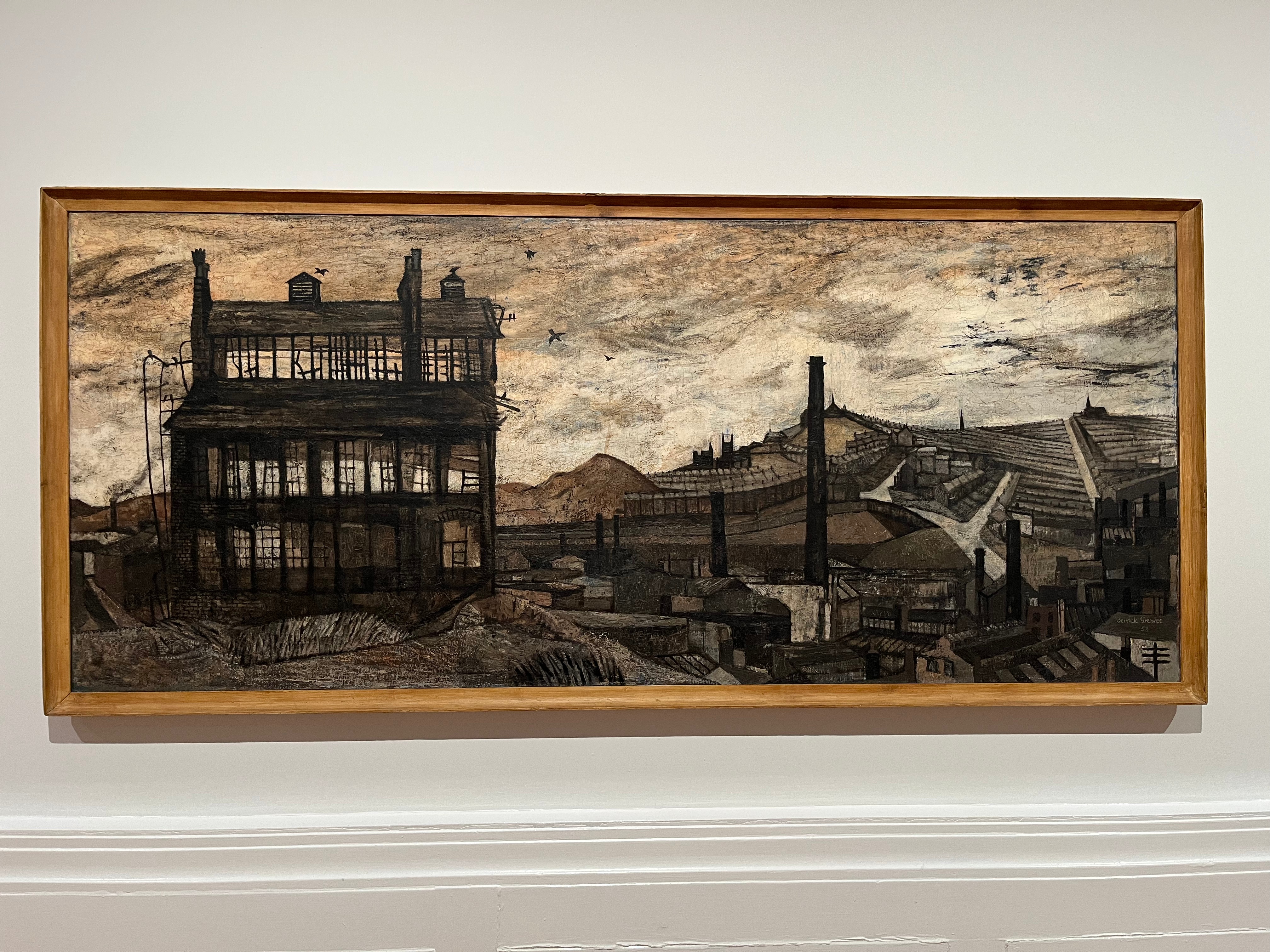
March has serendipitously coincided with the wider launch of Sheffield’s Culture Strategy, and several funded events for creative practitioners across the city, so I’ve made the most of all the city-wide networking opportunities this has afforded (and lovely free lunches). An excellent session led by Create Sheffield (for whom I’m a Trustee) on Activating Sheffield’s Culture for Children and Young People at the Workstation, another on health and wellbeing – Thriving on Creativity in Sheffield at SADACCA (what an amazing space, and an astonishing array of organisations working in this area), a third on Culture and Climate held at Site Gallery, and an online session by Julie’s Bicycle for RivelinCo on Green Freelancing. Although there were overlaps across these sessions, it was lovely to get out and about and reconnect with old colleagues, and meet new ones, now I am based in Sheffield once again. I’ve also been to a very exciting Music in the Round meeting (I sit on their ACE Ambition and Quality Panel). And I thoroughly enjoyed the Derrick Greaves exhibition at the Graves (less so the two John Hoyland shows at the Millennium Gallery).

Painting of Sheffield by Derrick Greaves. Industrial buildings in blacks, greys and browns against a cloudy sky.
A Derrick Greaves’ painting of Sheffield.

Beyond Sheffield, I enjoyed a Playful Places Network zoom session: The Art and Benefits of Staying Playful by Katie Rose White, and with my GLAM Cares Board/Co-founder hat on, hosted a superb training session on Trauma-informed Practice by the always brilliant Louise Thompson (which I think should be compulsory for anyone who has anything to do with education in its broadest sense). I’ve also undertaken two Professional Reviews for the Museums Association’s AMA, been to an event about potentially being a Green Party Councillor (and decided it’s most definitely not for me!) and I’ve been to several events connected with the launch of Piers Cross’ important documentary Boarding on Insanity. And I am very fortunate to still be having coaching sessions.

I gave two lectures for my former programme at the University of Sheffield (Creative and Cultural Industries Management). The first was on museum learning, interpretation and exhibitions, and the second was on museum activism – both of which seemed to go down very well with the students, and I certainly relished the opportunity to be teaching again (more of this would be very welcome, although HE is in such dire straits that I suspect this won’t be an option for much longer – and I’m sending solidarity to all colleagues currently dealing with mass redundancies in the sector…) 

Fern and amazing fern shadows on a wall in Sheffield's Botanical Gardens.
Fern shadows.

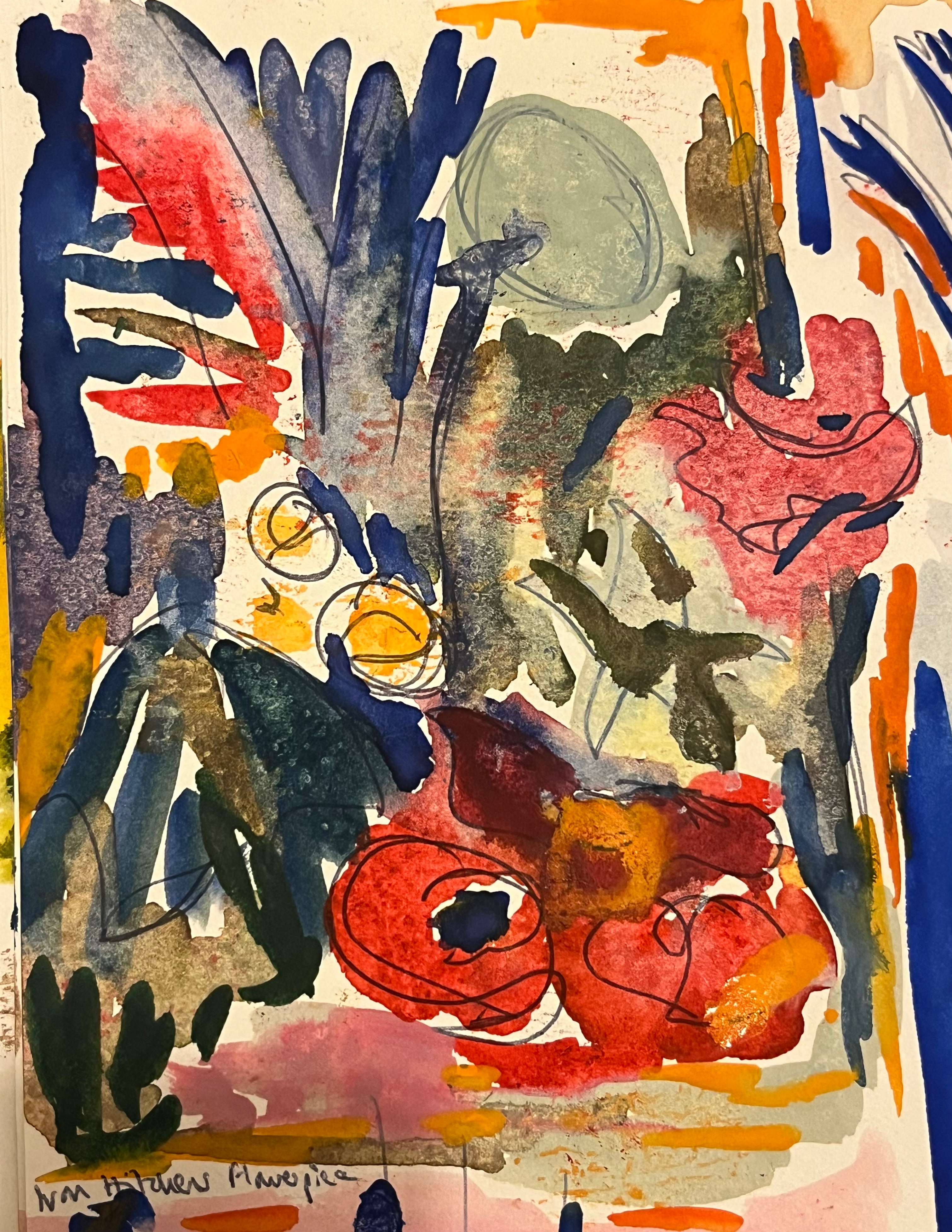
This is a creative sabbatical, and although all the above things are creative (or at least, my approach to them is), I will also mention what other things I’ve been tinkering with… I’m enjoying my weekly evening sketchbook class led by Colette Cameron in Dana, a local café: it’s particularly refreshing to be doing something so very hyper-locally, and I am loving experimental mark-making, idea-gathering, and learning new ways to see. I’ve sung in a (very challenging) concert at the Roman Catholic Cathedral with my choir, the Sheffield Philharmonic Chorus, in which we bravely attempted four world premieres with a sigh of relief when we got to Fauré’s Requiem at the end. I’ve had my Mum to stay for 10 days for her birthday and Mothering Sunday, and we’ve been on lots of expeditions (Wentworth, Elsecar, Sheffield’s Botanical Gardens, Bakewell, Pot House Hamlet, Brodsworth). I’ve walked: my local Bolehills, Damflask, Dale Dike, Ashford in the Water and Monsal Dale.

Colourful watercolour with biro ink, based on Ivon Hitchens' work, by me (Alex Woodall).
Biro ink and watercolour by me, inspired by Ivon Hitchens.

I’ve been to the Crucible to see A Streetcar Named Desire (impressive as ever, but what a bleak play), to the University Drama Studio to see The Effect and to the Showroom to see the NT Live Dr Strangelove with Steve Coogan (brilliant and so terrifyingly relevant). And I’ve listened to some podcasts, particularly Laura Crossley’s Cultural Peeps interviews, and a fascinating BBC one by Kim Aris, the son of Aung San Suu Kyi (recorded last year, but I listened in the light of the devastating earthquake to learn more about Burma/Myanmar and why the different names given to the country). I also spent a weekend in London, catching the last weekend of the outstanding Medieval Women In Their Own Words exhibition at the British Library, and visiting Queer Britain and Camley Street Natural Park (all handy for Kings Cross/St Pancras).

Looking forward, I am thrilled to have been accepted onto the Art Foundation Course at Chesterfield College from September. I loved sharing my sketchbooks and ideas for projects during my interview there, and realised it was the first time I’ve ever done this. I also had a successful interview for the Sheffield CELTA course, although sadly the in-person course I’d envisaged doing intensively during May isn’t running as not enough people signed up – but I’m investigating other options for that. And I am hoping to be involved in Rotherham’s Children’s Capital of Culture in the coming months. And who knows what other possibilities will emerge.

There is no wonder I haven’t finished reading the book I started weeks ago (Samantha Harvey’s Orbital, which I was loving but might need to start again now). It is taking quite a while to ‘unlearn’ work and stop the busy-ness. Can burnout be a thing now, I wonder? Anyway, I’m hopeful I might get better at letting go and might feel less guilty about doing a bit less rushing, and more slow looking, wandering and wondering in April.

So what is a creative sabbatical? (originally posted on LinkedIn 14 March 2025)

“It’s a grand thing to get leave to live.” Nan Shepherd (1893 – 1981)

It’s been a couple of weeks now since I left my wonderful colleagues at York Museums Trust to take on a new adventure.

I’m calling it a ‘creative sabbatical’. But what on earth does that mean?
No, I am not going back to my previous role after a brief pause. No, I haven’t retired. No, I am not going mad. Yes, it is terrifying. Yes, it is exciting. Yes, I think I am brave.

I’ve worked for a lot of amazing organisations over the past 25 years (and some less amazing ones), as well as undertaking freelance consultancy, creative facilitation, teaching and academic research. With each institutional role, I’ve taken on more and more leadership responsibility, with bigger and bigger remits. But I haven’t really stopped to think about why I’ve done this. In fact, sometimes I just haven’t stopped at all, let alone stopped to think.

It’s a bit of a cliché, but last autumn, I had a few days in hospital followed by some time off work to recover from surgery. I also started learning more about perimenopause, and reading about transition and trauma. I discovered that my body was trying to tell me something, and realised how short life is.

Having some enforced time out made me reflect on my values, remember what makes me tick, where I feel I belong, and where I make a difference. I value creativity – both the creativity of others, but also exploring my own creative unknowing. I am also insatiably curious and love learning and unlearning, imagining and noticing, and facilitating others to do the same (often using objects and art). I also understand how important it is to care for people and planet, and to listen to and look after ourselves.

So in what I suppose is my ‘silver jubilee’ year of working life, I am taking some time to re-set. It’s a pause that isn’t really a pause at all, but a journey.

I will be taking some courses (the art foundation course I have wanted to do since I was 18). I will be doing more within my local community in Sheffield and in nature. I will be playing with objects and materials and words. I will be facilitating imaginative learning and inspiring curiosity. I will be developing my creative consultancy work, and I will be open to collaborative work opportunities when they arise.

Please do get in touch if you are curious.

On memory, trauma and living objects

On Sunday afternoon, I set foot into the Sainsbury Centre for the first time in five years. It is a place that broke me – quite literally – and it is not an exaggeration to say that I’ve been haunted by the repercussions of this ever since, physically, emotionally, and in my subsequent life decisions (including financial and employment). Going back though (with an excuse of a lovely wedding anniversary party and staying with friends over the weekend) felt like something I had to do, part of a journey of somehow putting the pieces back together, or at least packing them back into the box. I hadn’t even been back to Norwich since I sold my house and left East Anglia. In my head, in the run-up to going, the entire weekend visit had been built into something potentially pretty explosive, and I wasn’t even sure whether I would go back to the Sainsbury Centre while I was there.

I did. And memory, as I learnt on Sunday, is a strange thing. As I approached the building, full of anxiety and that butterfly feeling in the pit of my stomach (mingled (un)helpfully with a hangover), it all felt surprisingly unfamiliar. A sort of distant hallucination or a dream where some parts are far too vivid and other parts blur and drop off at the edges. This, to the extent that I could no longer visualise much about what it was like to work there, or rather, to get there, to just be there, and I had even forgotten details such as where to find the stairs to the mezzanine (wobbly), what the loos looked like (rustier), how to navigate my way round the underground exhibition space (disconnected). The familiar/unfamiliar are ideas I’ve played with throughout my whole working life, and here they were, writ large.

View of the Sainsbury Centre with sculptures outside

So as well as my curiosity in going there to see what it has become under its new director, Jago Cooper, and its subsequent 50th anniversary relaunch focussing on living art and the life force of objects (which I had heard about from former colleagues, and thought I would love), I found it even more incredible that my brain has actively deleted so much – presumably as some sort of protection. And I suppose this validated to me a bit that my trauma was real, when sometimes I have even doubted that. So you could say it was a pilgrimage of many layers… Catharsis? Closure? I’m not sure.

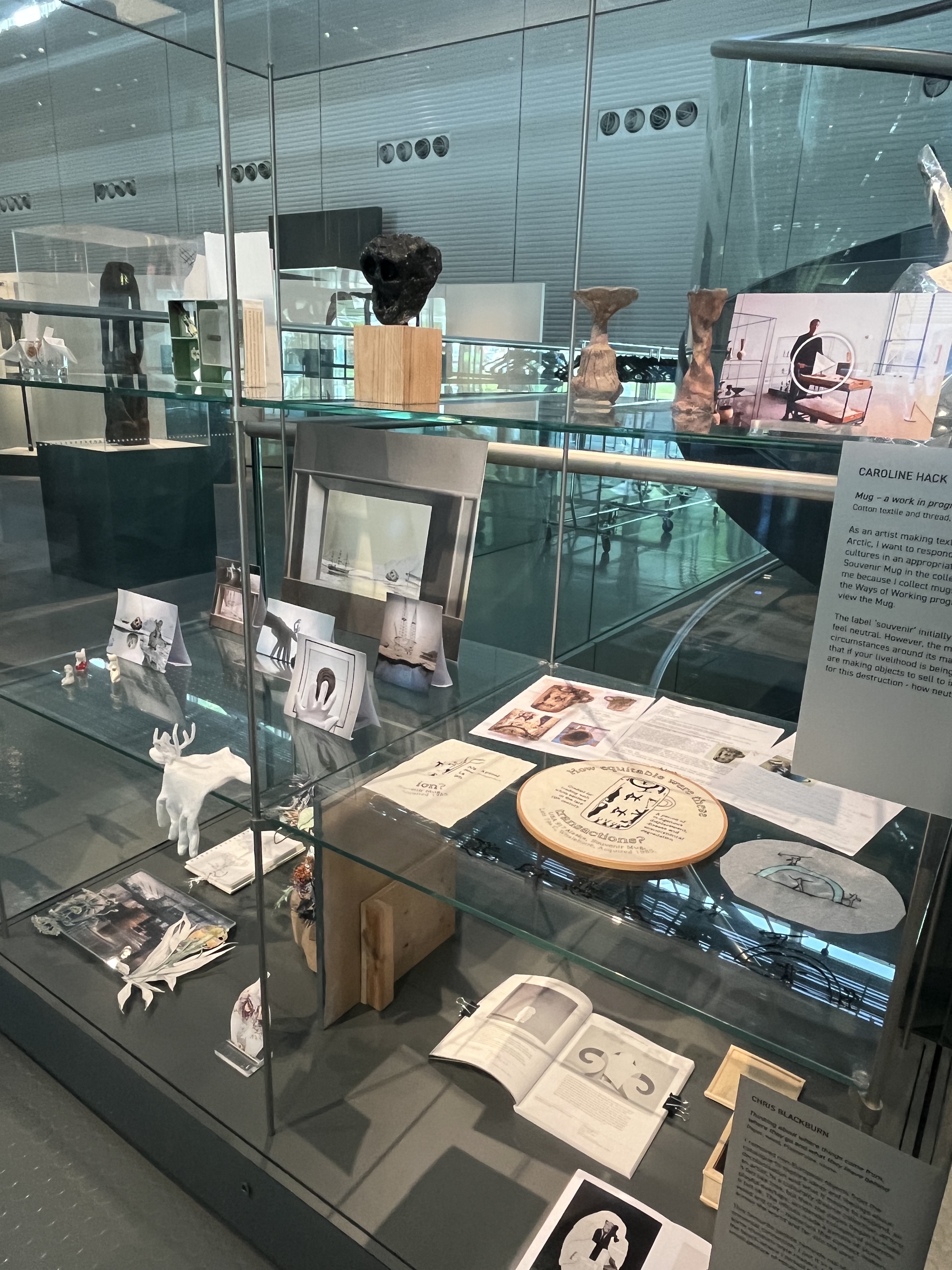
Anyway, my first impressions of the space (the overwhelming red bit aside), were how wonderfully visible all the learning programmes – the people, their objects and their ideas – are throughout the spaces. Two cases on either side of the welcome desk contain works by artists from what, back then, we called the ‘artists’ programme’. When I was there, display and visibility of learning programmes and any sort of engagement activity was a constant uphill battle, and any small victory felt like having won a war.

Artists’ programme work on display

As an aside, last week, I went to the beautiful funeral of a friend and former colleague from Manchester Art Gallery, Martin Grimes. Yes, it has been a week of immense and intimate and exhausting emotions. Martin taught me many things: about wonder, noticing, gentleness, creativity, and he also shared the idea of doing ‘skunkworks’ projects – where teams of creative people just do things to see what will happen, largely under the radar. (The Mary Greg project at Manchester Art Gallery was exactly this in its early days). This approach is very much how I view much of what I enabled during my time at the Sainsbury Centre, and the artists’ programme was one such. So while I love to see this getting the visibility it needs (and the works and narratives were wonderful), I also felt the loss of something that was originally a bit secret and hidden. Which seems an interesting sort of paradox to someone who usually likes, and sees the world as, a paradox.

My visit was also thankfully, and unexpectedly, filled with friendly faces and conversations with four former colleagues, none of whom I was really expecting to see last thing on a Sunday afternoon. This distraction may have meant that I didn’t get the full welcome spiel – the pay as you feel element (wonderful), and the introduction to the new Smartify app which passed me by on this visit (but which sounds like a good thing). But what I did remember, was that it was a place where some wonderful, warm, kind humans worked, and it feels good to at least remember that part.

And of course it’s also a place with some wonderful, curious, trapped objects. I’d heard prior to my visit that Jago’s vision (very much ‘Jago’s’ vision in the conversations I’d had), was very much about the lives of objects. As someone whose PhD thesis mingles anthropology with theology and museum studies, and who has been involved in research in India entitled ‘what do objects do?’, to explore our sensory entanglements with objects in art galleries, thinking about the life behind those things, I was excited about this vision, and keen to see how/whether it pervades. It’s certainly far removed from a previous disdain for even having a vision in the first place.

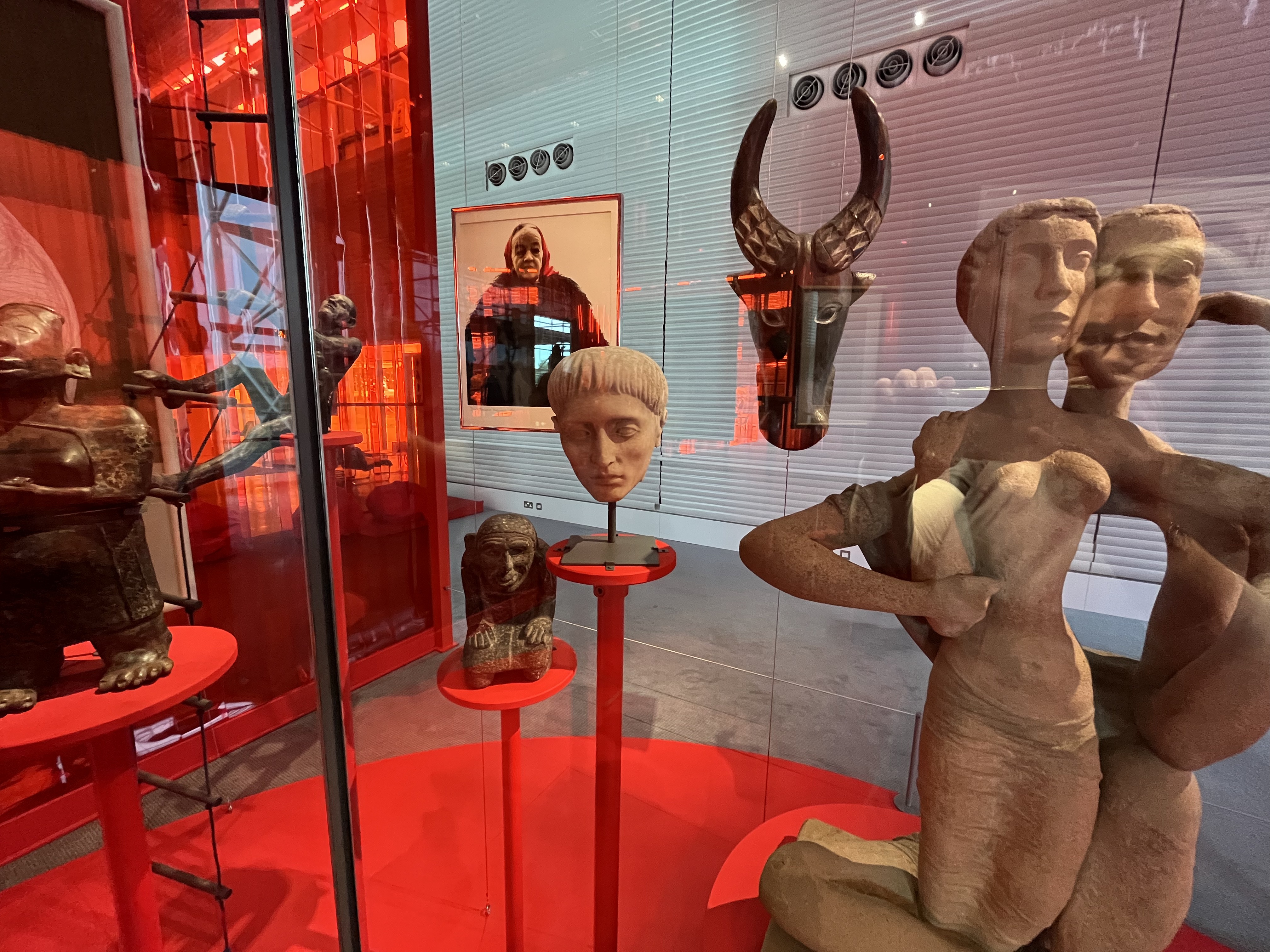
Being in a museum case (stared at by art as life force)

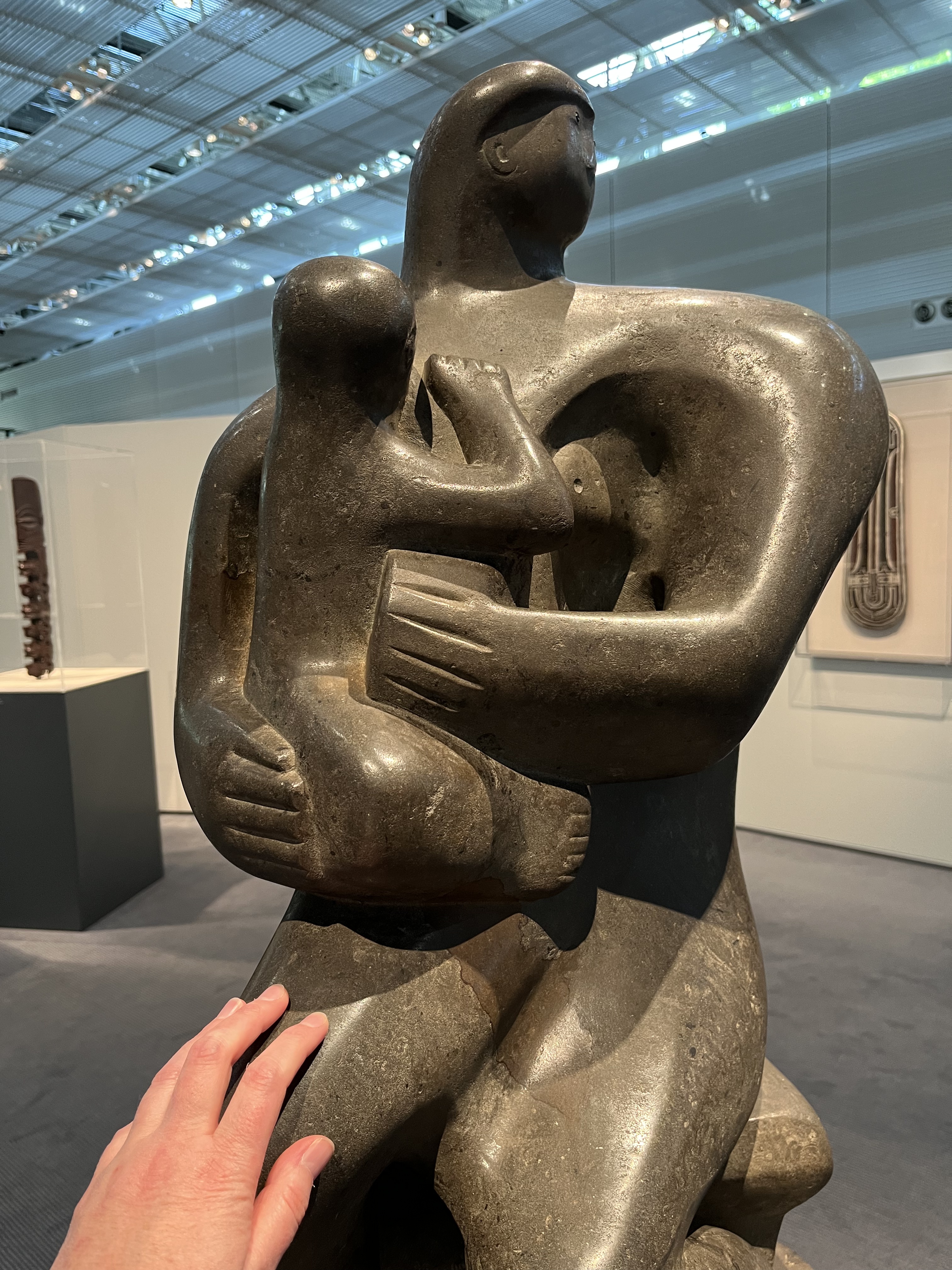
It wasn’t clear from the outset that this vision is the idea that does pervade. There was no hugely noticeable different feel in the main living room space from what was there before. I’d heard/seen that visitors can now hug Henry Moore’s Mother and Child, but still felt I needed to ask permission to do so (it feels amazing). I love the idea that new life will be breathed into it through an ever-changing patina, tracing the touch of its making, adding other lives. This is what I’ve wanted of art galleries for so long. It feels slightly unhinged – in a good way probably, and while of course I did take a selfie, it made me slightly uncomfortable to do so. Rethinking the value of senses other than the visual, understanding that there are various forms of knowledge, and that imagination, experience, emotion are just as (more) valid sometimes than context is deeply exciting. Yet I still felt a bit nervous. What if…?

Touching Henry Moore

I explored the new Living Art red zone in the East End space. Is it red because blood (and so life) is red? I wasn’t sure. I don’t like the red at all. I’ve no idea what the materials are that have been used to build it, but it feels harsh, unsustainable, too primary. Many years ago now, I was fortunate to visit children’s museums in California and Arizona on a research trip. The best of those were the subtle ones, constructed of natural materials, muted colours, plywood, paper, string, bits of junk. The red clear plastic felt to me scientific or medical, in a way that the activities and participations within are absolutely not. I am not sure how permanent the structures are (hopefully they are not), but I found myself worrying about what would happen to all this construction afterwards.

Living Art area

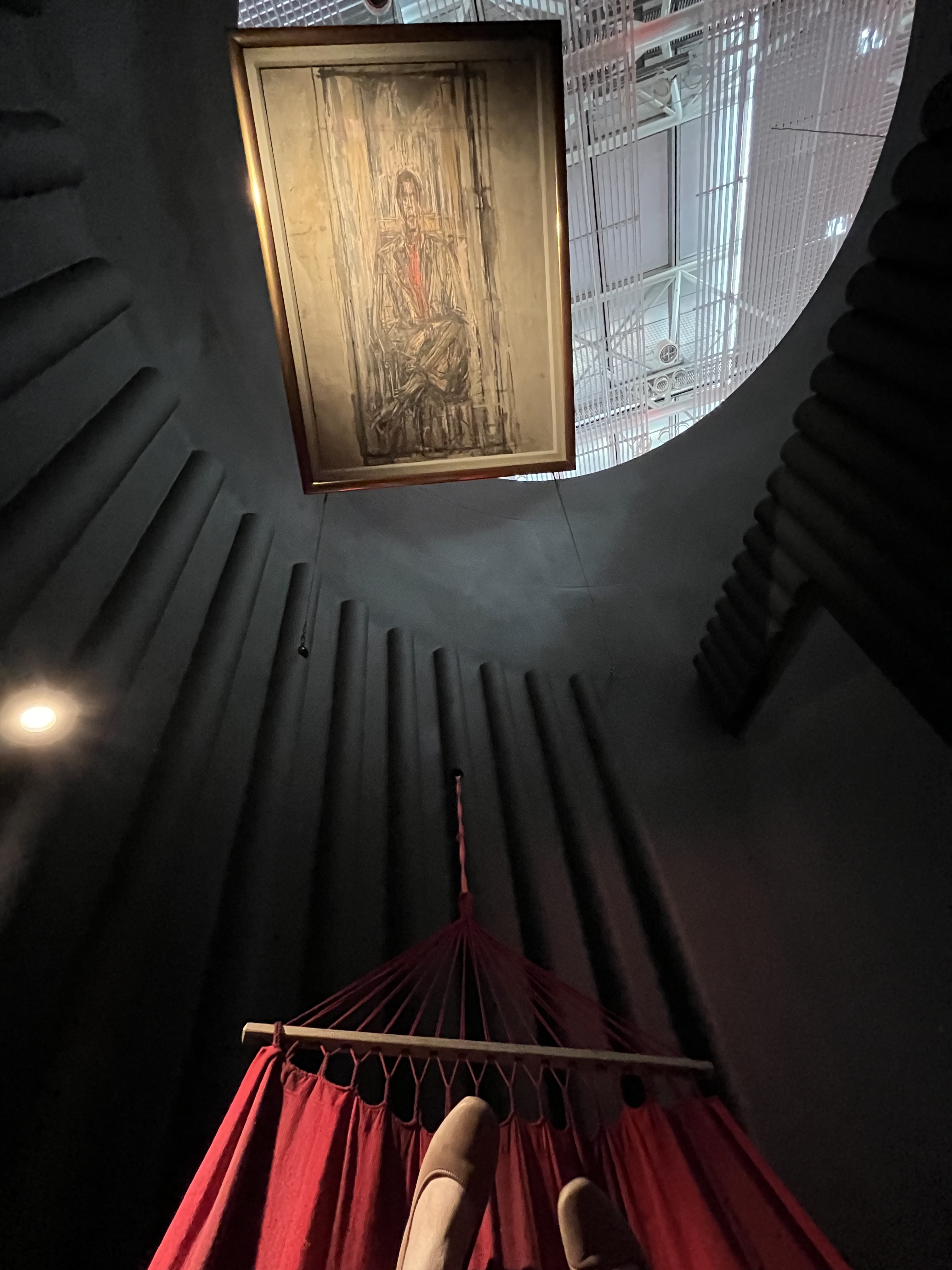
I really loved some of the ideas though: being inside a proper museum glass case, and being stared at by myriad sculptures and portraits was surreal, playful, fun – I’m not sure it made me think of the art as living. It made me have a heightened sense of my own entrapment I suppose. Getting into a hammock (while feeling ropey) to look at a Giacometti painting and the Foster ceiling above could be a new way of thinking about the gaze, a gimmick, or both. As it was, I think I was more worried about the whole thing coming off the hooks and me splatting onto the floor. A living kaleidoscope of mirrors, hidden peep holes for looking, places to create work from simple and lovely materials. I think I liked these making spaces best. It is indeed different from what has been there before. It takes a lot of the ideas from a publication called Lie Down in the Gallery by the Young Associates with one of the Learning Managers, and shouts them from the rooftops. It is good to see the space transformed, and will be particularly fascinating to know how visitors respond, and whether the visitor demographic changes in a space where certainly five years ago, it really needed to shift if the place were to be relevant.

For me, there is much more in the ideas here than in the design.

Lying down in the gallery

Upstairs was a wonderful exhibition of large scale ceramic funerary vessels by Julian Stair. This was actually my highlight. This is how a gallery can and should be socially engaged and have real impact in the world. That the learning team had worked with the Cruse bereavement charity, and that local people had wanted their loved one’s ashes incorporated into his new works I found incredibly moving. And the associated works curated from the Sainsbury Centre collection, curiously juxtaposed alongside are beautifully displayed. A simple table for visitors to reflect on loss through holding a button was a really lovely and inviting activity. Little touches like this from the learning team made so central. If only I had had that sort of support. (Yes, I did at times feel weirdly jealous, weirdly as though had I not left, then things might have worked out after all. Such complex emotions from one short visit – hence this need to write a bit.)

Funerary related objects from the Sainsbury Collection
Julian Stair exhibition

I went (probably too briefly) to see the downstairs exhibition, Empowering Art, which focussed on indigenous art from the NW coast of America. The story of living art told over and over again. ‘If you cannot understand them, don’t worry – you are not always supposed to.’ A statement I of course love, given my predilection to unknowing, but sometimes I felt that its constant repetition was out of a lack of confidence, rather than the boldness that this new vision and way of thinking about objects publicly shouts about. It is an exhibition for learning a lot of things about a lot of things: I think a visitor needs to be in a particular mood for this sort of gallery visit, and I probably wasn’t in the right space for this. Smallpox, Potlatch laws, children’s residential schools – indigenous oppression.

Empowering Art exhibition

The narrative tone of this exhibition really does try to resituate and reframe knowledge. I was left a bit frustrated though by some of the text: ‘At that time museums and scholars were focused in their work on the idea that the Northwest Coast culture was dying, and perhaps that it should die or that its death was inevitable. They sought to collect, study and kept it under their own terms.’ But then the curious final statement on that panel simply read ‘Modern scholars know better.’ Do they really? All of them? Surely if this were the case, we’d have seen a lot more dismantling going on in museums.

The Sainsbury Centre relaunch has also inspired two books to be published alongside it. The first, The Future of the Sainsbury Centre, is a sort of manifesto of the new vision. I don’t like this book. While I had the expectation that I would love it, I am left a bit cold. I wanted to see references. I wanted to see a less jumbled (dare I say, better written) account (it feels slightly flung together at the last minute). I wanted the idea of lifeforce not to be presented and repeated as the emperor’s new clothes, and in a way whereby repetition diminishes the claims. It all feels slightly pretentious and over-stated and without recourse even to a bibliography.

What I do love though is the Handbook for Living Art. A very simple little book in which artists, the learning team and others have come up with some ways of looking and articulated what it is that they do in their practice. It’s a beautifully designed book, simple yet complex, building on what gallery learning is and can be, articulated thoughtfully with reference to artists and thinkers, global and local.

While there, I also loved revisiting my favourite shell, about which I once ran an Object Speaks lunchtime session. And I loved seeing how something as simple as putting lovely photos on the windows of the learning studio made it so much more visible. Outside, I loved the (new) Caro sculpture near the lake in the UEA Sculpture Park, mirroring the brutalist ziggurat buildings of the campus (I wondered whether this architecture in turn seems to echo the brutal behaviour currently going on within UEA as an academic institution faced with insidious cuts, uncertainty and redundancies due to previous profligacy, the Gormleys perched on the rooftops shouting even louder than usual). Maybe that’s a metaphor too far.

Caro sculpture mirroring the UEA ziggurats

So anyway, that’s my little two-penneth worth. I probably won’t go back for quite some time, but that feels fine. I’ve been, I’ve seen and I’ve survived.

(Please note that this still feels raw, and I may not reply to comments.)

What is the Matter?

What is the Matter? is a new Arts Council England funded exhibition being held at Kelham Island Museum until 29 September 2019, and is the first show of new art collective Material Voice. Founded by Gillian Brent and Sarah Villeneau in 2018, this group of seven women artists based at Yorkshire ArtSpace comprises Heliya Badakhshan, Gillian Brent, Mandy Gamsu, Seiko Kinoshita, Kate Langrish-Smith, Clee Claire Lee, and Sarah Villeneau. Although working in various media, coming from different nationalities, and at different stages in their careers, together, they are all interested in the experience of being women makers, of making in Sheffield, and of using different materials.

What is the Matter? is their resulting exhibition, a delightful and thought-provoking exploration of materials, which unpicks stories of Sheffield and the city’s history as a place of manufacture. Sometimes this is through revealing forgotten corners of the steel industries, sometimes it is through making light of the excesses of the cutlery industry, but always it is through challenging the viewer to see and think in new ways. Above all, the exhibition is a wonderful rummage – a creative response to Kelham Island’s fabulous collections and the stories often hidden within its objects. The responses are diverse, yet the exhibition feels cohesive.

Clee Claire Lee

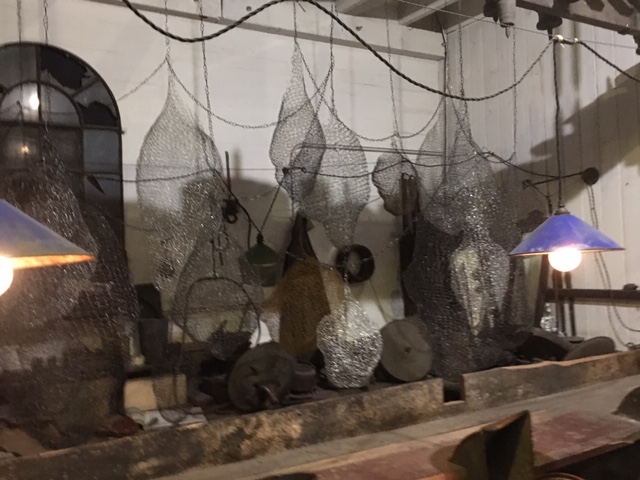
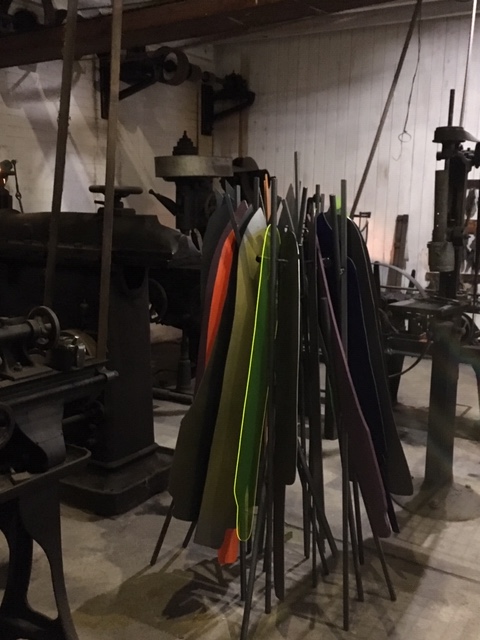
Varying in scale as well as in material, the artists’ work is often placed within existing museum cases, balanced on larger objects, or as an addition to a ‘staged’ room. Finding the work by exploring the museum is engaging in itself, with some pieces that leave you stopping in your tracks, and others that lend a wry smile. Large installations include Clee Claire Lee’s stunning steel wire sculpture ‘Visibilising the Invisible’, crocheted and suspended in Tom Parkin’s workshop to represent the often silent work of Sheffield’s women bearing children, and Gillian Brent’s ‘Work Life Balance’ in which bright human-sized acrylic knife blades are positioned amidst workshop machinery.

Gillian Brent

Experimenting with scale as with materials is particularly noticeable in the work of Seiko Kinoshita whose small, playful and colourful paper sculptures are directly inspired by the shapes of the huge lathe next to which they are found – these are in contrast to her usual work in much larger textiles. Working as a peer group collective on a collaborative museum-based project has clearly been significant, enabling risk-taking with new materials, reimagining familiar objects and inspiring new ways of working. This is also true in the work of Heliya Badakshan, whose use of lubricant oil as the basis for her piece provides a new way of thinking about the Crossley engine, but importantly about the reflective properties and materiality of oil itself.

Heliya Badakshan

I love Gillian Brent’s use of knives from the Hawley Collection (from a box of ‘spares’ and not accessioned ones in case you were wondering) which sprawl through the little kitchen of the 1916 house near the Little Mesters’ street, not least because of the irony that many of those employed within the cutlery industries would not have been able to afford the objects they so painstakingly made.

Mandy Gamsu

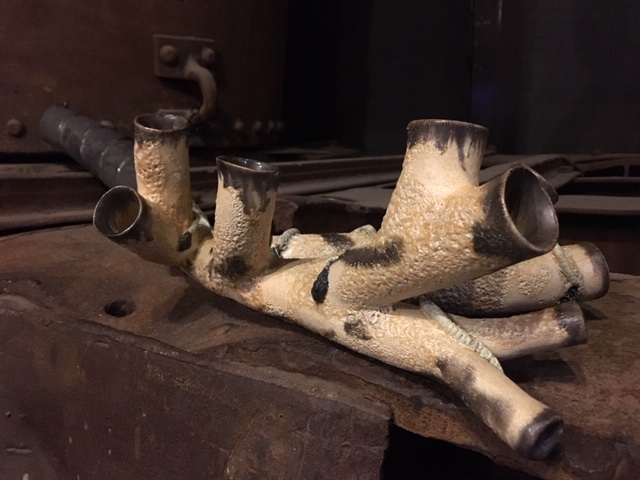
This idea comes across brilliantly in the work of Mandy Gamsu, whose garish and toy-like take on that absolute essential of everyone’s kitchen cupboard – the asparagus dish and tongs (!) (from a James Dixon & Sons catalogue of 1880) is both amusing and disturbing – as is the work of Kate Langrish-Smith whose ‘Electric Etiquette – Plastic when Wet’ based on the pestle and mortar tools of snuff-making is a more adult and highly visceral response, calling out be touched. Sarah Villeneau’s delicate and bodily ceramic listening pipes, ‘The Girl that Makes the Part’ are precariously balanced on a vast heavy industry machine, remembering the stories of the ‘Munitionettes’, women recruited for the war effort but paid less than men, and still having to deal with domestic chores while battling with explosions of molten metal on their skin and no health and safety at work.

Sarah Villeneau

This exhibition is only on until 29 September: definitely recommend a visit for anyone who enjoys seeing museum collections and stories being played with from new creative perspectives.

(Originally written as review for Our Favourite Places).


Dissent: Museums Association Conference in Belfast

I’ve just got back from 5 days staying in Belfast for the excellent dissent-filled Museums Association Conference 2018. It was my first visit to the city, and indeed to Northern Ireland, and it has, just as its title suggested, inspired both hope and change on a personal as well as professional level.

I would like to say a huge thank you to the Museums Association for awarding me a Trevor Walden bursary (to Sarah Briggs for drawing my attention to this, and Tamsin Russell for organising it), which enabled my attendance. It seems fitting to read about Trevor Walden himself, a man who, amongst various accolades was instrumental in establishing my alma mater, the School of Museum Studies in Leicester while running the museums service there. I would also like to thank everyone at the Museums Association – its staff and team of volunteers – and the helpful, friendly and patient staff at the Belfast Waterfront Hall– for their hard work, and of course thanks too to all speakers and fellow dissenting delegates.

Belfast. What a city for a conference on the theme of dissent! Roisin Higgins, our conference host, introduced Belfast as a place that ‘breaks your heart’ – but also as a place of ‘creativity, joy and courage’. In my short time there, I found all of this (and much more).

Here, in no particular order, are some of my initial reflections: on the city, on dissent, on the conference, on my learning, and on my hopes for the future.
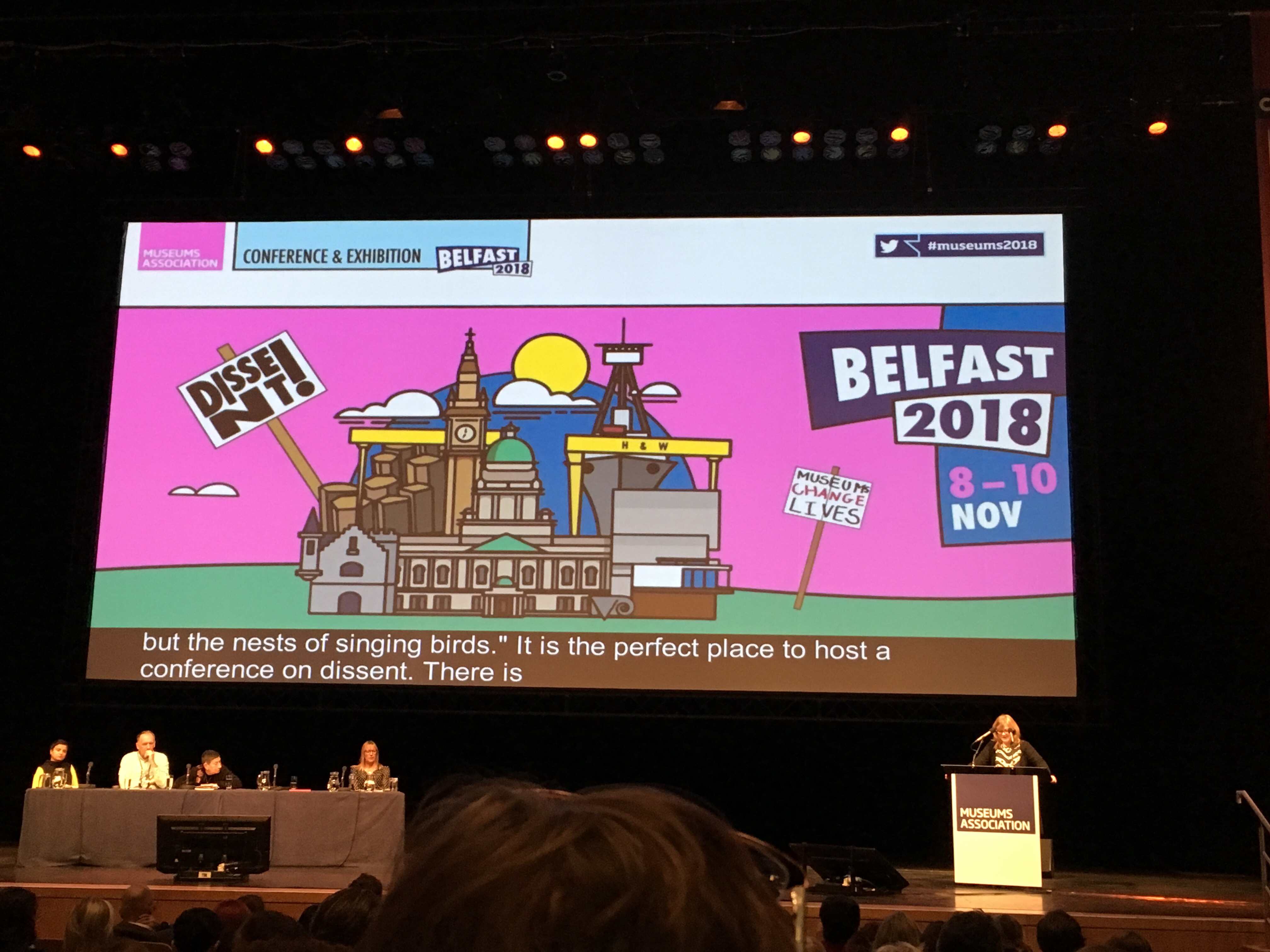
Welcome to the conference in hall

MA Conference 2018: Welcome

Belfast: City of culture 

Staying at the Easyhotel was a great find, as its helpful manager, passionate advocate of the city, Kevin, used to be Head of HLF for NI (!) and was full of tips, perfect for a museum geek. As well as a packed conference timetable, I also used my time in Belfast (Weds-Sun) to actually get to know the city a bit. I really had no idea what I’d find – no idea that the city was surrounded by beautiful purple hills and rocky outcrops. Even in what felt like the bleakest parts of city, the countryside – and freedom – beyond, was very present.

Expressions of ‘creativity, joy and courage’ were all over the place in Belfast’s museums: in the Linen Hall Library where I had lunch on my first day, I got my first taste of political posters; at the stunning City Hall where we had a lovely drinks reception courtesy of the city of Belfast (and which would definitely be worth a longer visit next time as it houses a museum of the history of the city); at the Ulster Museum and its open-ended Troubles Gallery, and crowd-pulling Dippy exhibition; on the brilliant organised tours to the Crumlin Road Gaol with superb guide Terry sharing his knowledge with just the right balance of humour and trigger warnings prior to discomforting experiences (something that did not happen in a later conference session on medical collections and babies in jars which I found incredibly difficult to be confronted with, with no warning); at the Ulster Folk and Transport Museum with piglets and donkeys and a packed event for miniature railway enthusiasts; at the Titanic Experience – but equally on board its tender SS Nomadic and in the actual stunning drawing offices of Harland and Wolff (now the lovely bar of the Titanic Hotel – thanks to Kevin’s recommendation!). Just listing all this is making me a bit dizzy – and giving me good reason as to why it was so tiring. I clocked 25.3 miles of walking. And this doesn’t include the miles of thinking and voice worn out from talking to lovely colleagues and friends old and new…

The conference was framed with the brilliant Rita Ann Higgins (on CryinAir, Belfast being ‘clean and posh’, and on guilt in Irish) and Glenn Patterson (‘up your hole’): I love the way the conference involves people from outside the sector – more of this!
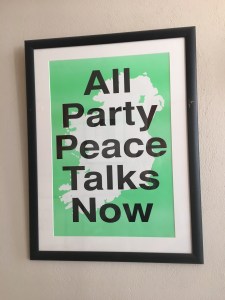
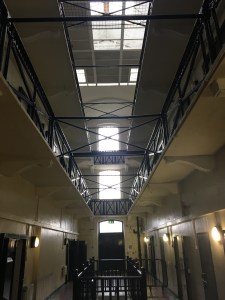
img_7302   img_7434   img_7459  img_7570

Belfast: City of fragility

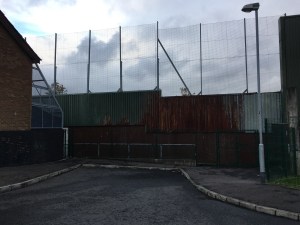
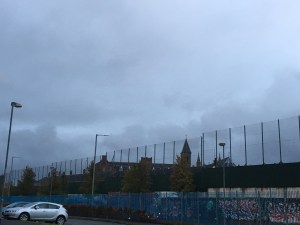
On the Wednesday, I started my time in the city with a (non conference organised) political walking tour of West Belfast. Beginning at the bottom of the Falls Road at Divis Tower, site of the death of the first child to be killed in the Troubles, we were led by former IRA member Jack. (Divis is named after a mountain, but, I reflected it could also stand for ‘division’, even now alas…) It is not every day that you meet someone from the IRA, and it was incredible to hear his perspectives. He focussed particularly on the roots of the Troubles in the civil rights movements of 1960s and as a campaign for social justice. He was also very keen to tell us that it wasn’t simply a Catholic v. Protestant thing. This part of the tour culminated in seeing Bobby Sands’ mural (whose story apparently was the first news story to ever capture my attention as a 3 year old in 1981, wondering if he’d eaten yet), and then a walk past the ‘peace wall’ – an oxymoron if ever there was one, with mesh barricades and cages over people’s gardens. I just had no idea.
img_7334 img_7337  img_7341 img_7344

We then met the second guide, a staunch Unionist, Mark, at the gate between the two communities, which still locks at 7pm every night. I asked Jack how the tour worked, whether he and Mark were friends… No. They were professional colleagues who said hello to each other – but basically, that was that. No crossing into each other’s spaces. So then Mark showed us the sadly neglected areas off the Shankill Road. Unlike Jack, he did speak of the situation in terms of Protestant and Catholic. And we walked along the road itself, to the site of the bombing of Frizzell’s Fish and Chip shop in 1993. The poppies, the images of the Queen, the (violent) murals. I felt weirdly much more uneasy in this area, especially after seeing a memorial with text panels and propaganda demonising Jeremy Corbin, horrific images of bodies… It is all so fragile, so complicated – and so neglected by the British media and in our own education system. The whole thing left me feeling a complete sense of ignorance, of not knowing, and being let down because it is not taught. And because who knows what will happen with Brexit. Fragility.

img_7359  img_7364  img_7370 img_7376

Dissent

So to the actual conference itself. I recently wrote a blog post about being defiant. And I think that the idea of dissent shares some similarities – perhaps too with what Sara Ahmed calls ‘willfulness’. There is something necessary about being willing to dissent – to be opposed to the prevailing idea – for democracy, and because usually this is connected with unequal hierarchies of power: inequality. But when does a dissenter become a dissident? A question for us all, but absolutely central being in Belfast, in Northern Ireland, amidst all the turmoil of the Troubles. And what happens when dissent does not bring about the radical change it aimed to do? Or when everyone is dissenting but in different ways without a unified cause – or with ‘opposite’ causes? Or with violent ones? The idea of how we tolerate the intolerant is bound up in all this, and was a strong theme throughout the conference. How do we include people that we hate and fear within our spaces? Should we?

Three dissenters were there throughout the conference: Elaine Heumann Gurian, Paddy Gilmore and Sara Wajid. (I’d met Elaine some years before, and was reminded of one of my Leicester PhD colleagues from Germany telling her then that she was ‘so old’ (she’s inspirational at 81!) – meaning to reflect that she was ‘so experienced’, but it got lost in translation and made us all, including Elaine, laugh a lot!). Elaine situated herself as a German Jew from America, completely unprepared for the horrors of Trump. Strangers seeing each other in public places is, for her, the bedrock of peace. Paddy, in NI, talked about needing to know one’s values – and moral core, and that it takes courage to say when you dissent. Sara talked of her experiences at BMAG, bought in as ‘commissioned dissent’: it is hard to make change as an insider, but that so often people are brought in to make change when an organisation is not ready or willing to be changed. Can a museum ever be decolonised? How can we provide positive conditions for provocation? ‘Dissenters generally don’t get sent to conferences’, was one of Sara’s comments that has stuck with me: it is a rare thing to have power to actually effect change…

Festival of Change

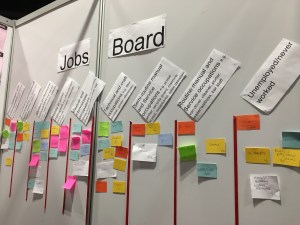
I completely loved the Festival of Change (although it is still positioned at the peripheries of the conference, and I’m not sure about this… Museum as Muck, the Vagina Museum, the Museum of Dissent, the Museum of Femininity – perhaps all of these could/should have had a central stage – although I also really like the fact that they don’t – that they are just there and in everyone’s face…) But as well as loving the Festival of Change, it left me very uncomfortable. Discombobulated. And it left me reflecting that actually this is the very best state I could have left in: because it is when we feel uncomfortable about a thing that we need to do something about it. Dissent. I don’t identify as working class, but the Supermuckers’ (@museumsasmuck) shop and jobs board sticks in my head and left me with lots of questions about class and injustice and privilege and entitlement, that are very difficult. I left pledging to tell people about their work, to donate to Arts Emergency, and to ensuring that class and inclusive practice is absolutely part of volunteering, recruitment, and board processes. And I came across something to read: the Panic Report. At the Museum of Dissent, where only the curator was allowed to impart the actual ‘factual information’, we looked at the challenges of (teacup) labelling in a ‘reverse’ anthropology – where ‘the accompanying tealeaves are of particular importance to the natives of the isles and cause the nation to be at a constant tipping point’ with civil unrest between the PG and the Yorkshire clans (!); at the Museum of Feminity there were sensory exhibits with instructions: touch me, smell me, insert me, taste me… at which I learnt more about how to do a breast examination than I ever knew before (using a commonplace silicone boob used in USA schools), that contemporary smelling salts are not to be inhaled deeply, and suggested an addition of a moon cup to the collection; at the Vagina Museum I struggled to label all the parts of a clitoris and loved the (b)unting. This could definitely be a new festival line. In fact, the whole conference did feel like a festival: that mixture of there always being something to do, while there’s also something else equally exciting that you could be doing.
img_7417  img_7418  img_7412  img_7411

Museums are not neutral

And neutrality is not neutral anyway. I don’t have the t-shirt, but there is one, and it is doing a roaring trade. I loved Laura Raicovich’s keynote on this theme: in particular that she’d resigned from her post as Director of the Queens’ Museumin the most diverse area of New York because of frictions between her inclusive values and those of the board of trustees. Taking inspiration including from liberation theology, and other civil movements, she talked about Art Space Sanctuary– a place for us to declare our spaces as sanctuaries and safe public spaces for all people regardless of race, gender, ethnicity, immigration status, sexuality, religion, politics etc. And yes, this is absolutely right and positive and good. But again there was that question: who decides what is or is not appropriate? Where is the boundary between promoting a set of values (of inclusion), but including those whose voices we don’t agree with too? How can we be political but not partisan? I’m not sure I have the answer to this yet (and maybe if anyone did, the world would be a whole lot more peaceful). And just as museums are not neutral – neither are we… So we have to take a stand.

Knowing your values

I think for me, thinking about, and trying to define my own values has been the strongest and most important thing to come out of the whole conference. I was lucky to have been allocated a coaching slot as part of the careers development element, and spent a very useful, hopeful and change-making hour with coach Louise Emerson from Take the Current. So I was already immersed in thinking about what makes me tick (and what I want to make me tick) when I went to Janneke Geene’s hosted session, led by gurus Hilary Carty, Richard Sandell and John Orna-Ornstein, on ‘values-led practice in troubled times’. Janneke began with a comment that our work is (and has to be) an expression of our values. Having recently left a job because of this, this was a deeply moving and important session.

Hilary began by listing her values – bish bash bosh – as easy as that! (Except I’m sure it was not easy.) For her, to be true to herself is about 1) integrity, 2) generosity and 3) curiosity. Those are her key values, from which all else arises – mingled in with the need for self-care. If we are going to challenge things, we need to look after ourselves along the way. Yes. Richard and John then talked about the Prejudice and Pride project – how Richard participated in Exeter Pride with the National Trust’s rainbow banner, with all the spectators saying ‘OMG it’s the National Trust’! The Kingston Lacey project came post-Felbrigg and culminated in a debacle over whether or not the rainbow flag could be flown from the rooftops in Dorset. I completely admired the absolute honesty of the speakers in this session: opening themselves up to really talk about how it was for them in such a generous and trusting way.

I’ve been thinking about what I value ever since, and have the beginnings of a long list – but it needs rethinking and refining, and probably turning into a useful ‘bish bash bosh’ checklist. At the moment, and in no particular order, it is something like this:

  • Imagination and curiosity
  • Not knowing– humility, letting go, and opening up
  • Courage – to speak out, take risks, make change
  • Giving – generosity, being kind and caring for people and planet
  • Inclusion– connecting, reaching out, welcoming in, sharing
  • Equality and justice– for people and for the planet
  • Body/mind/spirit– materialities, embodiment, senses, emotions
  • Doing and thinking– research and practice as intertwined

One other thing I have done post conference is to write a list of all the people I had conversations with, the people I didn’t have conversations with but wanted to, and the people I want to send follow-up emails to as a result. I love networking. Writing a list though is something I haven’t done before. It took a while but I think will be useful. (The app was brilliant, including for this).

Engagement

There were lots of sessions that dealt with amazing community projects as always, but here I’ll just look at what engagement looks like in the digital realm. Martin Grimes, my former colleague and web manager at Manchester Art Gallery kicked off thinking in this vein with his open and honest talk about #nymphgate, and how the gallery simply wasn’t ready for the storm post Guardian articles following the arranged feminist take down of Waterhouse’s Hylas and the Nymphs by artist Sonia Boyce. He started with an image very familiar to me from the Mary Greg project back in 2008. But rather than talk about this project as having been a good way of engaging people (which is the language I usually use, as it opened up the stores for rummaging by members of the public), he used it to talk about its digital presence in a more negative way: basically one of broadcast, rather than engagement. The old problem of didactic learning rather than any other sort of constructed and open ended learning. We are, he said, on the whole, pretty good at engaging with people within our museum spaces; this is what learning teams do brilliantly. But this is still not so in the digital world. Often people dealing with social media have nothing to do with the learning team. Not quite hiding under their desks, Martin described how the team at MAG ‘lost control of the message’ and by the end were ‘not even sure what the message was’ (interestingly this debacle coincided with a lack of director, and an absent deputy director). PhD student Maria Arias then talked about how she’d been able to keep track of these Twitter conversations for her PhD research using free software TAGS, a very useful practical piece of advice. The discussion post-session was one of the most lively and honest in the conference. The closing comments by one delegate was that the whole scandal was nothing to do with the content, but it was about a pattern of voicelessness in the world. People in the current climate do not feel they are heard, but they do have a voice and so shout on social media. How do we as museums deal with this – giving space and a voice?

Opening up and letting go

The session on digital engagement was followed by absolute unit legend Adam Koszary from the MERL and his now infamous big sheep, soon followed by chicken in trousers – see his write-up here. Again, Adam talked about the distinction between broadcasting to people, and actually engaging people online. For me, the key to his presentation though was around knowledge of the collection. In order to open up the collection, to let go of it for people to engage on their own terms (which surely is what we all want – and what, had I been to the session on Collections 2030, I might have heard more about – alas a regrettable clash), we do still need to know our stuff. Don’t just put a picture up and tell people what’s in it, but make stories, embrace experimentation, allow people to take it and do as they will, grounded in what is there. Social media can only be used for debate, dissent and dialogue when it is treated as an engagement tool, not as a marketing tool. Yes. Social media should not just be done by marketing (unless they are skilled in communications and engaging with all audiences). It reminded me of the debates raging almost 20 years ago about digital in museums: ‘digital is not a department’ – everyone needs to embrace it. No department is a silo. Twitter at the MERL works because they know their stuff and engage people with it, with good humour as a way in. (Incidentally, I’m loving this week’s cock-related liaisons avec Le Louvre).

I enjoyed hearing Chris Rolls talking about his project 64 million artists. Everyone is creative.  An office of just 3 staff members had the task to develop digital resources for everyone to develop their own creativity. These can be found on DOTHINKSHARE. Interestingly, I think this was the only time during the conference that I heard ‘by, with, for’ (almost the ‘ofbyfor’of Nina Simon). And it was chaired by Ross Parry who is always generous and worth hearing as much for presentation/chairing style tips. But there were questions: yes, we can let go and give things over to online publics, but is the digital ever really democratic, when so many people do not have it or use it?

Mendoza

It is a year since I read and wrote a blog on the Mendoza Review on my way to the 2017 conference in Manchester. So it was interesting to be in a room – a very ‘top heavy’ room (with some comments that made me squirm and feel that there’s such disparity even within the sector – its ‘elite’ versus its own ‘muck’), with Neil Mendoza, Ian Blatchford and Laura Pye, sharing their thinking a year on. One positive discussed, was that the ‘HLF/ACE peace agreement’ had been signed. But Laura Pye said it as it is: recognising that the panel was not a diverse/representative one, and that the report did not do enough. That there is a crisis in the sector: funding, diversity, collections management and relevance. She talked particularly about funding. Her view was to support a mixed model of funding – including introducing a tourist tax – £1 per night per room would generate more money for culture than the whole current culture budget. Another pot would be the ‘cultural development fund’ – which would stop local authorities making a choice between health and culture for example. Sounds like a good idea. There’s a huge difference, she pointed out, between just surviving (as per Mendoza) and really thriving (as per the good old days of Renaissance). All panel members talked about the need to better articulate what it is we do – but particularly the difference that we make. And so it continues…

Hopes

Elaine ended the conference by saying she wants museums ‘to be forces for peace’. Maybe this is why we are all in it. Seeing people’s humanity is the first step in forgiveness. Vital in a city like Belfast. And this made me glad that I’d started the conference off by meeting and listening to Jack the republican and Mark the unionist in West Belfast. My hope is that one day they will go for a pint together.

If you’ve got to the end of this, well done! And thank you again to the Museums Association for supporting me to attend a brilliant conference.
All the world’s a stage…

I’ve been thinking about theatre and performance quite a lot recently.

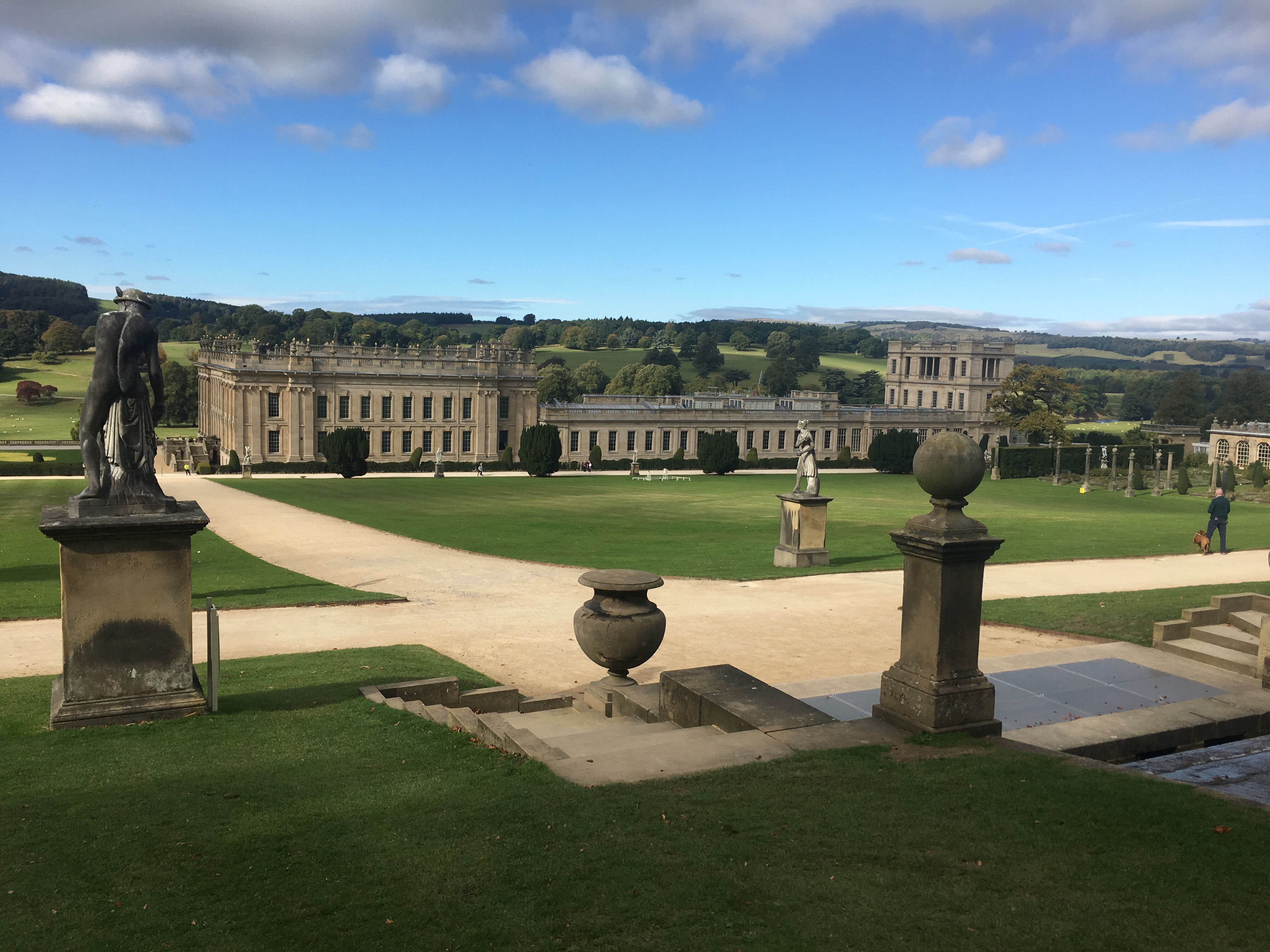
At the end of September, I was asked to facilitate three days of workshops at Chatsworth for the University of Sheffield by Professor of English, Jane Hodson. Three of her PhD students, now in their third year, are doing AHRC White Rose collaborative doctoral awards there: Hannah Wallace, Lauren Butler, and Fiona Clapperton. These three have been researching the lives of servants on the Chatsworth Estate in the 18th, 19th and early 20th centuries, by delving into largely untapped archives, finding amazing bundles of letters, exploring other found items, meeting with relatives, and wandering through the estate in search of its former inhabitants. Their exciting work has even been featured in national newspapers and on the BBC. They have uncovered some truly wonderful lives and stories as yet untold.

Photo of Chatsworth House

Chatsworth

Amongst other aims, the research project seeks to rethink interpretation in country houses by focusing on the whole life of its servants as they go about their daily business in the landscape, and not defining them just by role, as has happened in so much ‘upstairs downstairs’ research. My facilitator role over the three days was to work together creatively with these researchers, with other collaborators from the University of Sheffield including computer scientists, Dr Mark Stevenson and Dr Steve Maddock and theatre academic Professor Frances Babbage, and with staff from across most of the departments at Chatsworth (including collections, exhibitions, engagement, development, archives, interpretation, visitor services) to explore ways to make the research engaging and accessible for Chatsworth’s visitors – particularly those just walking through the landscape. Add into the rich mix the outdoor promenade performance company, Burn the Curtain, and a really exciting set of ideas emerged from the participants during the three days. Not least, and inspired by comments from Chatsworth colleagues, we talked a great deal about the house and its grounds and its staff as performative in and of themselves. Perhaps more on that another time.

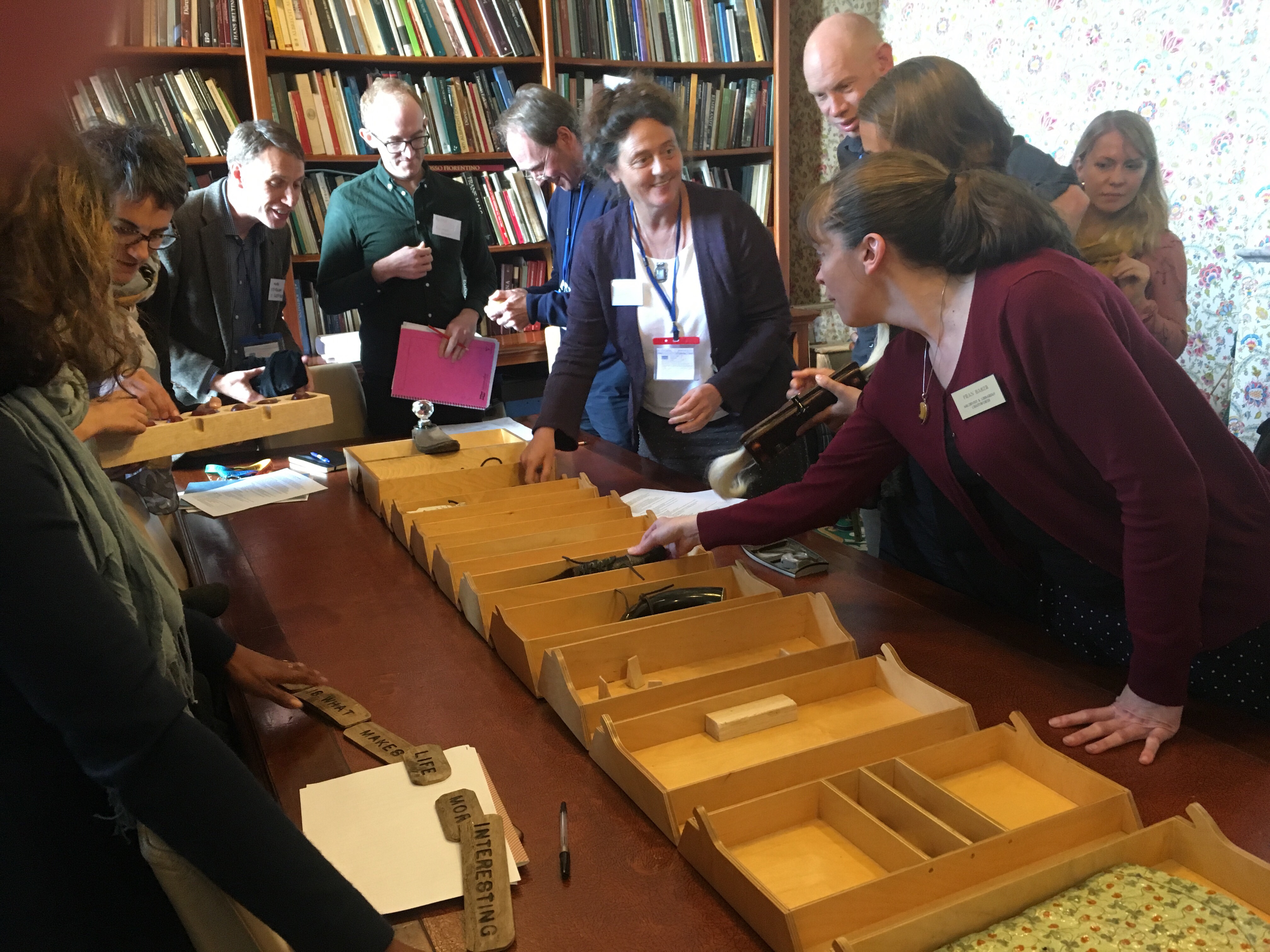
Creative workshop using objects

Using the Object Dialogue Box to facilitate ideas

Exploring the archives

Fiona, Lauren and Hannah exploring the archives at Chatsworth

It was certainly a wonderful opportunity to work closely with theatre professionals, Joe Hancock and Fiona Fraser-Smith, to explore what we might mean by place as performance by hearing more about their place-based work. One thing I’ve been pondering ever since, was a comment raised by Frances Babbage. She talked eloquently about the paradox that is performance. As audience, we are both utterly there, in it, immersed within the action on the stage, part of the story. Yet we are also at the same time completely aware that we are not and cannot be there. That we are inhabiting our bodies. Sitting on a seat. In a theatre. (Or wherever). With other audience members. Worrying about shopping lists and dentist appointments and defrosting the dinner. But also that the whole performance is make believe and of another reality. Two worlds. And perhaps the worlds of the imagination and of fact/reality collide and are made stronger because of each other’s existence.

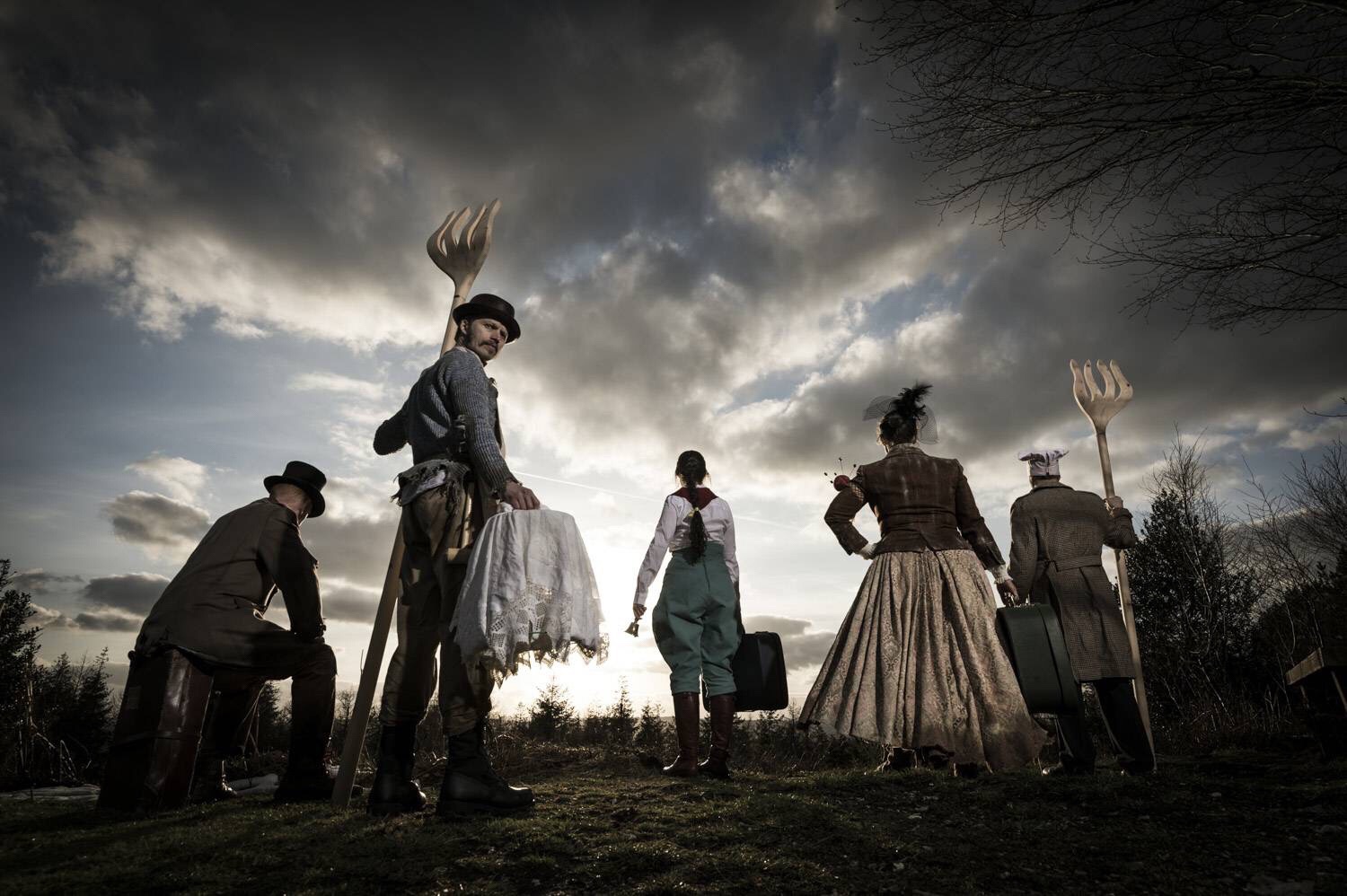
And by sheer coincidence, this piece of work and the ideas it generated have also happened at a time when I’ve been to various performances. Burn the Curtain were playing in Thetford Forest as part of the Forestry Commission’s Forest Art Works programme just a couple of weeks after the workshops. Joe and Fiona invited me along to see The Hunting of the Snark, based on Lewis Carroll’s nonsense poem – a quest through the woods to find the elusive snark. I went alone but was quickly snapped up to be given a suitcase to carry through the woods on the hunt. (We opened it halfway through to reveal some missing bloomers!) Audience numbers were about 100, and everyone had had to choose to identify with a particular group of characters before it started, each with its own characteristics and its own different objects as props: Baker’s cousins, Makers, Twitchers and Scribblers. I was a Baker’s Cousin. The performance took the form of a magical walk, a sensory immersion, encountering people and things – lots of fabulous objects (all beautifully crafted and environmentally friendly), projections, twinkly lights and mysterious sentences gathered along the way as we hunte. At times we split into our different groups, collecting different bits of evidence from new characters for the Captain (a strong female protagonist, I was delighted to see), eventually coming to a wonderful finale after we had walked for at least 3 miles in the dark. I was both immersed, but also wonderfully aware of other audience members, often chatting to them as we walked with wooden forks hanging round our necks, and jam jars full of provisions. I loved it.

People standing in a line, characters from the Hunting of the Snark

The Hunting of the Snark (image from Burn the Curtain)

Since then, I have seen two more plays: a performance about the life of Mary Shelley at the Maddermarket Theatre, and Rufus Norris’ NT production of Macbeth in Norwich. The blurring of truth and fiction, and boundaries between being there and not there were alive in each. For a start, I knew embarrassingly little about the life of Mary Shelley, of her radical parents – feminist mother Mary Wollstonecraft and philosopher father William Godwin, her tragic relationship with Percy Bysshe Shelley, and their familial connections with Lord Byron. So hers was a story exciting to learn. Facts. And with a stunning set reminiscent of Blickling’s book project that I’ve written about elsewhere. And with a haunting repetitive melody (think Mozart and Nine Inch Nails ‘Hurt’…) And with really good acting from the amateur cast. I loved it. And I learnt some new things about history and women and poetry and death and motherhood. But I was very aware of myself in the audience. Of it being a too small audience. And of knowing others in that audience. Whereas in Macbeth, I knew no one, but ended up irritated with the person sitting behind me for sniffling and rummaging about too much. And trying to ignore it only made me notice it more. But what a tale. What hideous characters. I’d forgotten how many people end up dead. Based on history, but again, the merger of fact and imagination, and being able to be there but not there. Performance. Is that what it all is?

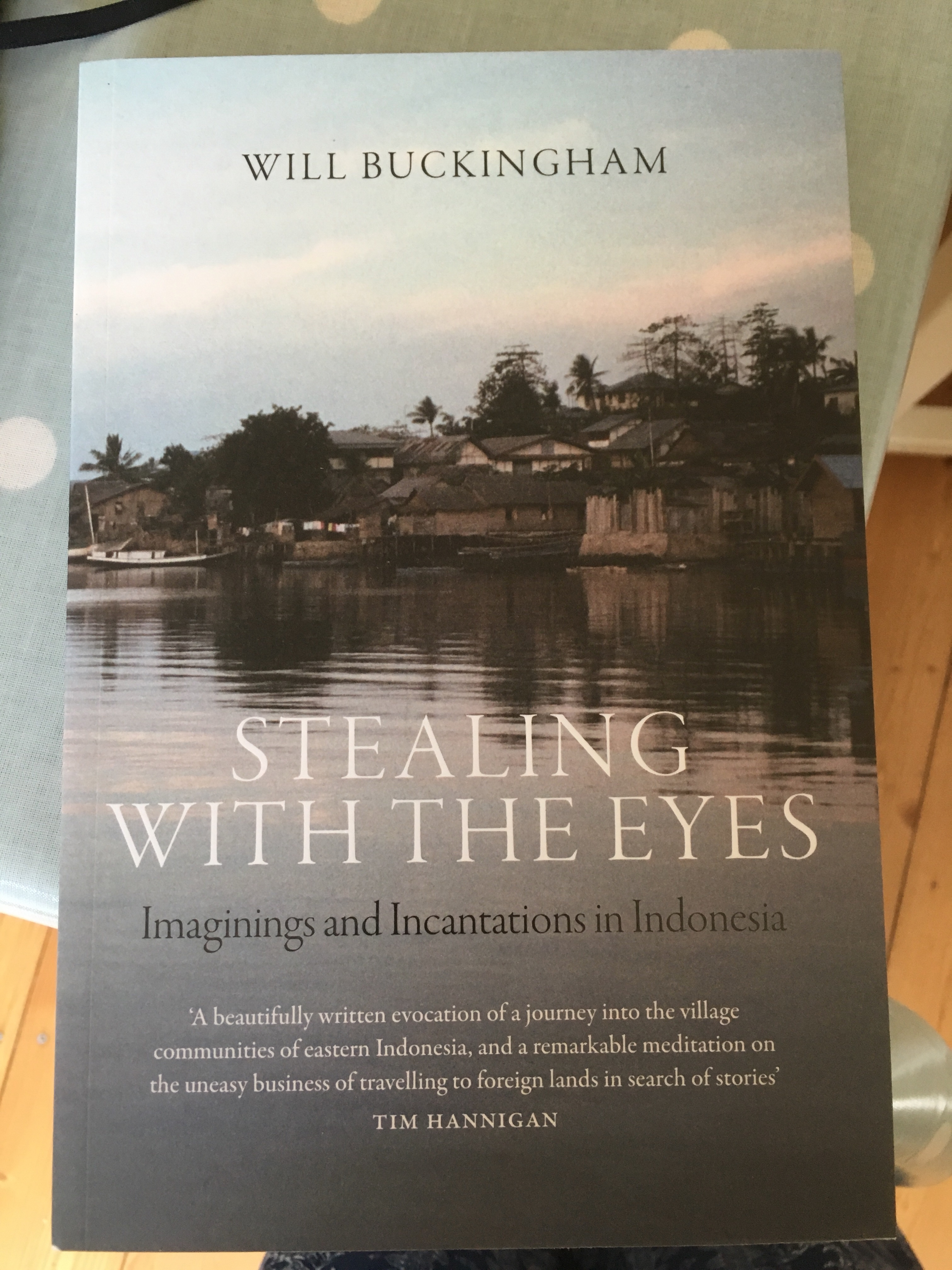
‘Stealing with the eyes’

The title of this post is the title of the latest book by my friend Will Buckingham (with the subtitle ‘Imaginings and Incantations in Indonesia’). I started reading it one night this week, and finished it the following day on train journeys to and from Cambridge. Quite a surreal way/place to read it, it turns out. I left the train at a point at which Will was on death’s door having refused an injection, and worried all day about what would happen to him. So it was a relief to get back on the train (after a day of Gormley, Tutankamun and Louise Bourgeois) to find out what happened next.

It is an absolute joy to read. It made me laugh out loud, cry, wonder, want to know more, want to go off to new places… All the things that a gripping – but real – book should be. I love it. It describes Will’s encounters in the 1990s – with people, sculptures, witches, octopuses, histories, insects, ancestors, weather, travellers, anthropologists, illnesses and medicines – I suppose really with life and death – in the remote Indonesian Tanimbar islands. Which I had never even heard of before I started this book.

But above all, it describes a growing concern with the (colonial?) activity of the anthropologist. The title ‘stealing with the eyes’ is a phrase used by one of the people Will meets, sculptor Matias Fatruan, from a place called Ruma Salut on the island of Sera, to describe what he sees outsiders doing when they come to ask questions, take photos, record conversations. How can an outsider ever understand the ways and lives of others, not least when they are entwined with the place, with the ancestors?

Anthropologists are not immune to fantasies of the exotic, even if anthropology has a hard time owning up to that fact… I, too, am guilty. And recognising the fact does not diminish my guilt. Perhaps it augments it. (Buckingham 2018, p.177)

It has made me think hard about my own research in India and my ambitions to return. Perhaps the only way to travel and to explore, is to do exactly that – to see what happens with no agenda? I’m not sure. There’s always bound to be a ‘failure’ in any sort of anthropological endeavour. But there’s still an absolute desire in me to go back and do some more exploring, meeting people, going to new places. But I think this is not because I think we can ever fully understand anything – but because we absolutely can *never* understand it. Going to an unfamiliar place is a way to recognise this. That we cannot know. We can just encounter things and see what happens. (And now am I sounding greedy, pretentious, privileged and like all of those distasteful things about anthropology…?)

Anyway, I highly recommend a read of Will’s book. I might have to read it again now. And think about new adventures.

The Word Defiant

In the LV at school (Year 9), I was somewhat rebellious. I still love my 13-year-old self. Part class clown needing attention, part provocateur needing to challenge authority. And perhaps because of this, I like the word ‘defiant’. I think teachers used it of me, with deliberate negative connotations. But I took it and owned it. I was defiant and I was proud of being so.

At about this time (actually I think it was the start of the MV/Y10), we read Ray Bradbury’s Fahrenheit 451 in our English lessons with Mrs King. The impact of this book was transformative. That books were ordered to be burned in some kind of dystopian totalitarian state was quite possibly the most shocking thing I had ever read. It was the job of firemen to burn books. How on earth could that be? Until the fireman called Montag was defiant. People rebelled. They learnt the books off by heart. And it was reading this that made me realise that books – or the things in them – change the world, and that learning was the most important thing there is.

So, going to see brilliantly titled The Word Defiant at Blickling Hall had a fair bit to live up to. It’s part of the ACE funded Trust New Art scheme, designed to open and shake things up a bit for new audiences, and is on until 28 October 2018. Theatre Company, Les Enfants Terribles have been commissioned to respond to what is the National Trust’s largest book collection in one of their house libraries. The library is about to undergo a massive conservation programme, and this intervention highlights the plights of books – both their environmental destruction, but also contemporary issues around censorship, banning, destruction through war and violence, natural damage,and threat to books by digital technologies.

IMG_5242

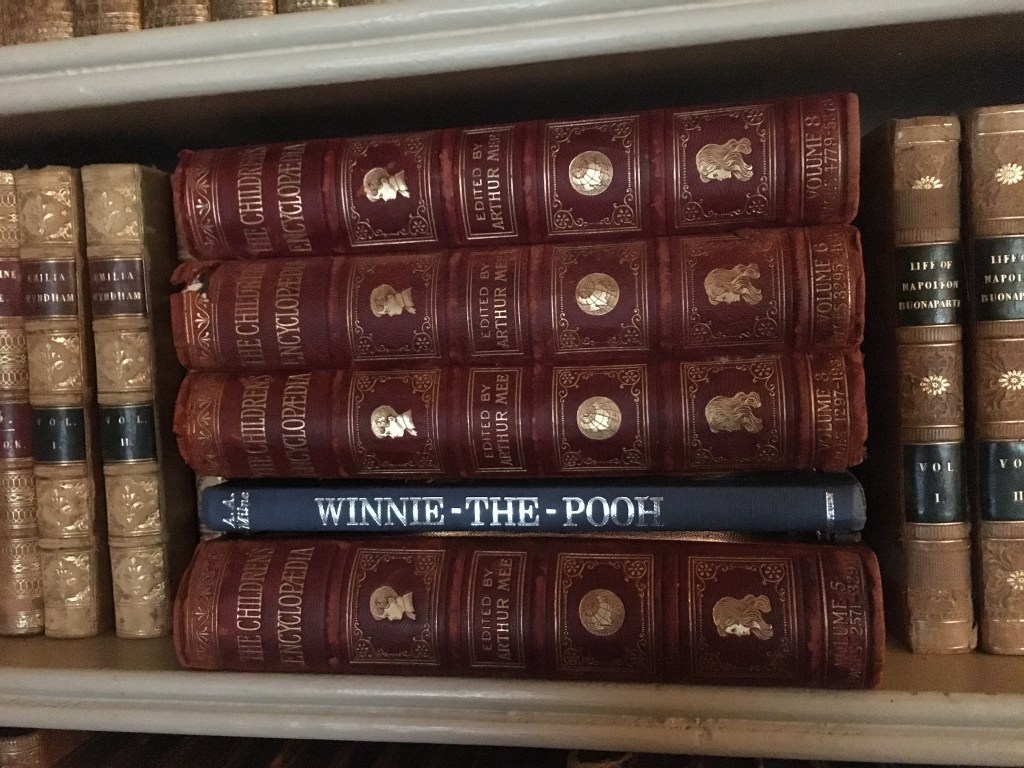
From the hushed audio of Chinese people reciting Winnie the Pooh (who knew this book was banned in China?), to an overflowing bath representing a library in Venice where books are stored in baths to prevent flood damage, to a stunning newly opened up room in the cellars full of burnt books representing the ISIS destruction of the library in Mosul, Iraq, this is such a thought-provoking, challenging and captivating creative response – it brings the house alive. I will remember the house because of this: it will not get muddled into a sea of other National Trust properties with their expected walk through dining rooms, four-poster beds, comical loos, and kitchens downstairs.

IMG_5248.JPG

At the end of the house, the library awaits, its books spilling out of the shelves and onto the floor. Living? I love the way that the latter times I have visited, more interpretation has been added – as if to explain themselves to the visitors who don’t like this novel approach to story-telling and getting people to think.

IMG_5260.jpg

One of my favourite things about this exhibition is the very mixed visitor response. Downstairs, an interpretation room has brilliant creative tasks. A redaction table taking its cue from a morse coded installation in the kitchen corridor.

IMG_5910.jpg

A giant scroll for visitor conversations. It would be amazing to evaluate this. I’ve been to visit on three separate occasions, and alas, the grumpy comments of the traditional National Trust going visitors have always outweighed the positive ones. People seem to be quite irate that books have been used, that the house has been contaminated with an artistic intervention, that they can no longer contemplate the great works of art on the walls and rooms stuffed full of antique furniture. I’ve also enjoyed talking to the volunteers – again, with very mixed views. Some of them, I notice don’t even talk about it, but steer conversations onto the actual books in the actual library. I love this almost as much as I love the installation itself. Here are some of the nicer comments I saw:

IMG_5269.jpg

Extraordinarily, this is an intervention by a theatre company. Amongst many other things, it leaves me wondering where the boundary is between this and contemporary art. Let’s have more of this sort of thing. Shaking things up. Being defiant.

I think I need to read Fahrenheit 451 again.

States of flux

I am currently in a state of flux. An adventure awaits, journeys to places, pastures new. I’ve left one thing behind and am toying with several exciting ideas about what comes next, whilst trying to enjoy the moment as much as I can.

We are constantly learning. Only this week, I went on an amazing course on how to make Mud Resist Textiles, at Print to the People in Norwich. Our teacher was the fantastic Sevanti Roy, now living in Norwich, but formerly working in Jaipur for textile companies including Anokhi, FabIndia and East. She’s what a good teacher should be: inspiring, trusting and allowing people to get on and learn for themselves. It was brilliant. A bit hot and sweaty, but brilliant.

IMG_5980

My test piece, including laurel leaf, bobbin, lids, door knob and traditional printing block

Anyone who knows me, knows that I have a lot of objects.  Things collected, found, bought, given. I took several of these along with me to see whether they would make interesting prints. I quite liked the combination of natural laurel leaf, plastic lids and door knob, bobbin and small Indian printing block (not for mud resist though, which needs to use bigger blocks with larger negative spaces). And circles were the theme of the day. I love the accidental seepage of indigo dye into mud, leaving a sort of marbled effect. I’m looking forward to making up the recipe for myself and experimenting with my laurel hedge… Is this the start of something?

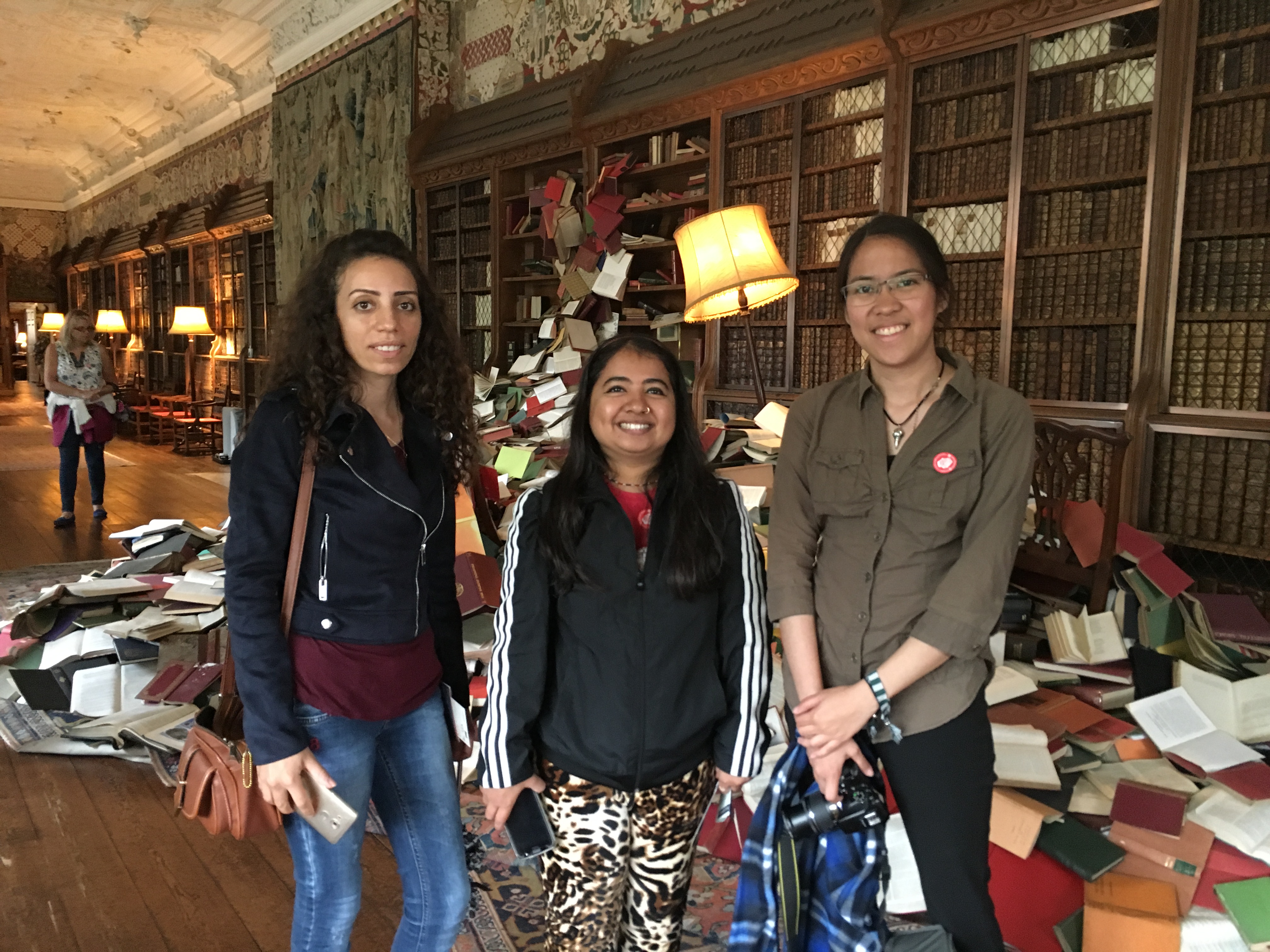
It’s funny how links to India pop up all over the place. The weekend before, I had kindly been invited by colleagues from Norfolk Museums Service to participate in a visit by three international participants from National Museums on the British Museum’s ITP scheme to Blickling Hall, to see ‘The Word Defiant’ (my third visit to this wonderful intervention by theatre company Les Enfants Terribles – another blog post on that forthcoming). It’s a small world: one of the visitors, Suruchika, works at the National Museum in Delhi which is also home to the National Museum Institute where I’ve worked. Needless to say, we had several friends and colleagues in common, and again, an idea began to spark.

IMG_5906.JPG

Hoda Chiyeh (Lebanon), Suruchika Chawla (India), Yohana Rosales Frias (Philippines) – on the ITP scheme, visiting Blickling Hall

So, although I’m not quite sure what will be next, I’m making the most of opportunities to get out and about, meet new people, think new thoughts, learn new things, and dream: que sera sera.